
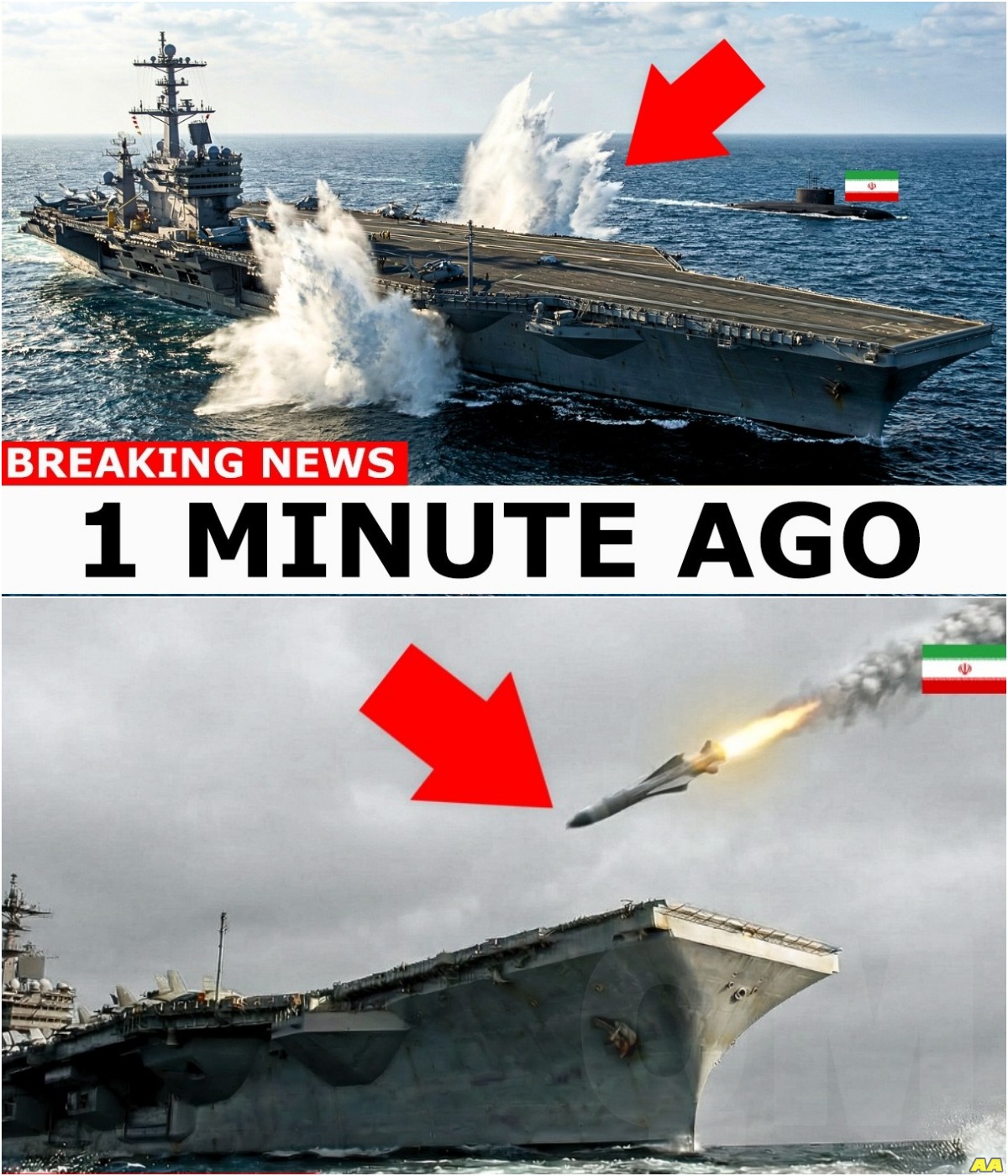
In a world where geopolitical tensions simmer just beneath the surface, the threat of naval warfare looms large.
One of the most chilling scenarios that military analysts often discuss involves a covert submarine attack on a U.S. aircraft carrier.
Imagine a situation where an Iranian Kilo-class submarine, equipped with advanced stealth capabilities, spent 11 days undetected in the Arabian Sea.
This submarine executed a meticulously planned operation, riding the acoustic shadow of a supertanker for four days before positioning itself directly beneath the USS Abraham Lincoln.
What happened next is a gripping tale of strategy, technology, and sheer nerve.
Join us as we explore this hypothetical yet terrifying scenario, analyzing the tactics employed and the implications for modern naval warfare.
thumbnail
The Prelude to an Attack
The Arabian Sea has long been a focal point of military strategy, particularly for the U.S. Navy.
With its vital shipping lanes and strategic importance, the region is heavily monitored.
However, the stealthy capabilities of submarines like the Kilo-class allow them to operate in near silence, making them a formidable threat to surface vessels.
In this scenario, the Iranian submarine utilized its advanced technology to evade detection, showcasing the evolving nature of naval warfare.
The Role of Acoustic Shadows
One of the critical tactics employed by the submarine was its use of acoustic shadows.
By positioning itself behind a supertanker, the submarine could effectively mask its presence from sonar detection.
This technique allowed it to remain undetected while moving into a strategic position beneath the USS Abraham Lincoln.
Such tactics highlight the innovative strategies that modern submarines employ to outmaneuver their adversaries.
Picture background
The Moment of Truth: Torpedo Launch
After days of stealth and careful positioning, the submarine was ready to execute its attack.
With the USS Abraham Lincoln directly above, the crew prepared to launch two torpedoes.
The first torpedo was designed to follow a decoy, creating confusion and drawing attention away from the real threat.
This classic military tactic aims to disrupt defensive measures and increase the chances of a successful strike.
The Second Torpedo: A Deadly Precision
The second torpedo, however, was where the true challenge lay.
Once launched, it quickly reacquired the carrier’s hull signature, demonstrating the advanced tracking capabilities of modern torpedoes.
With only 63 seconds between the launches, the crew of the USS Abraham Lincoln faced an immediate and dire threat.
The second torpedo raced toward the carrier’s keel, aiming for a critical hit that could incapacitate the vessel.
Picture background
The Response: Lieutenant Commander James Porter
As the situation unfolded, Lieutenant Commander James Porter was already airborne on routine patrol.
With 29 minutes of flight time under his belt, he was ideally positioned to respond to the unfolding crisis.
Porter’s training and instinct kicked in as he recognized the urgency of the situation.
His quick decision-making would prove crucial in the defense of the USS Abraham Lincoln.
The Countermeasures Deployed
Upon receiving the alert about the incoming torpedoes, the crew initiated their defensive protocols.
The USS Abraham Lincoln, equipped with state-of-the-art countermeasures, sprang into action.
The crew deployed anti-torpedo systems designed to intercept and neutralize threats before they could reach the hull.
This moment underscored the importance of preparedness and the capabilities of modern naval vessels in the face of emerging threats.
The Aftermath: Surviving the Attack
As the torpedoes raced toward the carrier, the tension was palpable.
The effectiveness of the USS Abraham Lincoln’s defenses would soon be put to the test.
In a dramatic turn of events, the anti-torpedo systems successfully intercepted the first torpedo, neutralizing the immediate threat.
However, the second torpedo, having reacquired its target, was still on course.
The Final Defense
In a race against time, the crew of the USS Abraham Lincoln worked tirelessly to ensure the ship’s survival.
With seconds to spare, the ship’s systems activated once more, engaging in a last-ditch effort to protect the vessel.
This scenario highlights the critical nature of training, technology, and teamwork in modern naval operations.
Picture background
The Outcome: A Hypothetical Victory
In this hypothetical scenario, the USS Abraham Lincoln emerged unscathed, thanks to the quick actions of its crew and the advanced technology at their disposal.
The Iranian Kilo-class submarine, however, faced a different fate.
As the U.S. Navy launched a counter-offensive, the submarine was detected and subsequently neutralized, marking a significant victory for American naval forces.
This outcome serves as a reminder of the complexities and dangers inherent in modern naval warfare.
Lessons Learned
The scenario illustrates several key lessons for military strategists and naval forces around the world.
First, the importance of stealth and advanced technology cannot be overstated.
Submarines that can operate undetected pose a significant threat to surface vessels, necessitating robust defensive measures.
Second, the effectiveness of training and readiness is crucial in responding to unexpected threats.
The crew of the USS Abraham Lincoln demonstrated the importance of quick decision-making and teamwork in high-pressure situations.
Conclusion: The Future of Naval Warfare
As geopolitical tensions continue to rise, the lessons from this hypothetical submarine attack remain relevant.
The balance of power at sea is constantly shifting, and naval forces must adapt to emerging threats.
The use of advanced technology, innovative tactics, and effective training will be paramount in ensuring the safety and security of naval operations in the future.
While this scenario dramatizes a potential conflict, it serves as a valuable exploration of the realities of modern warfare and the challenges that lie ahead.
As nations navigate the complex waters of international relations, the stakes have never been higher.