
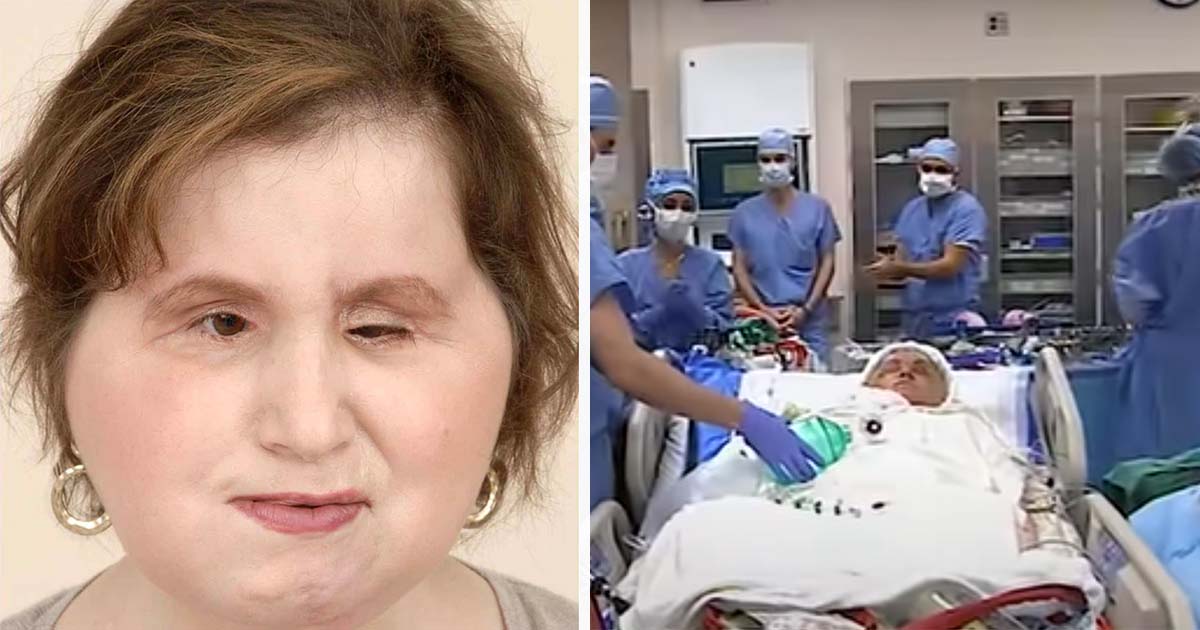
At 18, Katie Stubblefield believed her story had reached its final, heartbroken chapter. Today, at 21, she stands as a global symbol of surgical survival and human resilience. As the youngest face-transplant recipient in United States history—and only the 40th person worldwide to ever undergo the procedure—Stubblefield has emerged from a grueling 30-hour operation with a second chance at life and a transformation that medical experts are calling nothing short of incredible.
In an era where it is easy to become consumed by the minor inconveniences of daily life—a cold cup of coffee, a delayed commute, or mundane digital frustrations—Stubblefield’s journey serves as a profound corrective. Her narrative is a stark reminder to pause and appreciate the fundamental gift of existence, even when the “dream scenario” feels out of reach.
A Life Interrupted
Before the tragedy that would redefine her, Katie was described by her older sister, Olivia, as “fearless” and “a lot of fun.” A native of Lakeland, Florida, Katie’s teenage years were marked by transition; her family moved to Owensboro, Kentucky, during her sophomore year, and later to Oxford, Mississippi, where her parents took up teaching positions at a local Christian school.
As she matured, Katie’s personality took on a driven, perfectionist edge. “She wanted to be the best in all of these sports that she’d never even tried before,” Olivia recalled. “She wanted to be the best academically; she studied for hours, all the time.”
The Perfect Storm
By her senior year, the pressure on the teenager began to mount from multiple directions. Katie was battling chronic gastrointestinal issues that had already required surgical intervention. A previous appendectomy had led to complications, ultimately resulting in the removal of her gallbladder.
Simultaneously, the family’s stability was rocked when both of Katie’s parents were dismissed from their teaching positions. Amidst this turmoil, Katie found what she believed was a foundational romance with a classmate. The relationship was serious enough that the pair had already begun discussing marriage.
Everything shattered on March 25, 2014—the day Katie turned 18. Upon discovering texts from another girl on her boyfriend’s phone and confronting him, the relationship ended in an abrupt breakup. Heartbroken and overwhelmed by the compounding stressors of her health, her family’s employment status, and her lost relationship, Katie made a split-second decision that she no longer wished to live.
The Miracle of Survival
Agitated and hurting, Katie drove to her brother Robert’s home. Noticing her distress, Robert contacted their parents. Their mother, Alesia, arrived shortly thereafter, hoping to provide comfort. Katie, however, withdrew, refusing to speak.
While Alesia and Robert stepped outside to discuss the situation, the silence was shattered by a sound they initially mistook for a door slamming. They rushed back into the house to find the bathroom door locked from the inside.
Katie had attempted to take her own life by shooting herself in the face. Miraculously, she survived the initial trauma, though the injury resulted in the total loss of her facial structure.
This survival set the stage for one of the most complex medical undertakings in history. Three years later, a team of surgeons performed the marathon transplant that would give Katie a new face and a new future. Today, her recovery stands as a testament to the fact that even in the wake of the most devastating choices, there is a path back to the light.
The silence in the bathroom was the first sign that the world had shifted. “I tried to open the door,” Alesia Stubblefield recalled, tracing the moments of a day that would haunt her family forever. “I said, ‘Katie?’ And nothing. And then I said, ‘Katie.’ I said, ‘Are you OK?’ And about the third time I said, ‘Katie,’ that’s when my heart began to just palpitate.”
Her son, Robert, was hit by a more immediate confirmation of the tragedy. “At that point, I smelled gunpowder because it was, obviously, indoors,” he said. “And I knew exactly at that point what had happened.”
Katie Stubblefield had shot herself in the face. In those initial, panicked moments, both her family and the first responders on the scene feared the 18-year-old was lost. But against all odds, a pulse remained. Even more miraculously, as she was rushed to the emergency room, Katie found the strength to speak.
“When she was in that ER… she said, ‘Tell my mom and dad I love her—love them. I’m sorry,’” her father told ABC. “It took a lot of strength.”
A Wound Beyond Repair
The damage was catastrophic. Katie had lost her forehead, her nose, her sinuses, and the vast majority of her mouth, leaving only the corners of her lips. The structural bones of her jaw and the front of her face were gone. While her eyes remained, they had sustained severe trauma.
As surgeons began the grueling work of stabilizing her, the reality of her future became clear. On the very first night of her hospitalization, specialists delivered a sobering verdict to the family: her only path toward a functional life would be a face transplant.
“He said, ‘This is the worst wound I’ve ever seen, and I think the only thing that will give her any kind of life again will be a face transplant,’” the Stubblefields recalled. It was a medical term the family had never even heard before.
For Katie, the trauma had wiped her memory clean. She remembers nothing of the day she lost her face, nor much of the year that followed. When her parents finally explained the possibility of the procedure, her reaction was one of hope. “I had no clue what a face transplant was,” Katie admitted. “I was very excited to get a face again and to have function again.”
The Weight of Survival
The physical recovery was only half the battle; the emotional toll was equally heavy. When Katie finally understood the circumstances of her injury, she was overcome by a sense of responsibility.
“I never thought of doing that ever before, and so on hearing about it, I just didn’t know how to handle it,” she said. “I felt so guilty that I had put my family through such pain; I felt horrible.”
After being stabilized in Oxford, Mississippi, and treated in Memphis, Tennessee, Katie was placed on a waiting list for a donor. A year later, a match was found: 31-year-old Adrea Schneider had passed away, and her family had courageously agreed to the donation. Katie was transferred to the Cleveland Clinic in Ohio for a procedure that would effectively replace her entire facial tissue.
The operation was a feat of modern engineering, involving the transplantation of the scalp, forehead, eyelids, eye sockets, nose, cheeks, both jaws, teeth, and the underlying nerves and muscles.
Thirty-One Hours of Precision
On May 4, 2017, a team of 11 surgeons and a cadre of specialists—aided by virtual reality mapping—began the 31-hour marathon. The surgery was a resounding success.
“To reach this point of recovery has oftentimes been a difficult road to travel, but I’m thankful there’s been a road,” Katie stated following the procedure. She expressed profound gratitude to the Cleveland Clinic staff and a “grateful heart” to her donor’s family for their “incredible gift.”
However, the surgery was just the beginning of a new, intense lifestyle. Katie’s parents became her around-the-clock nursing staff, managing a daily medication regimen that spanned two-and-a-half pages. Her schedule became a full-time job of rehabilitation: physical and occupational therapy, braille lessons, and speech therapy four times a week.
Speech proved particularly challenging. With a new mouth and only a partial original palate, Katie’s voice took on a nasal quality she described as being “like a frog.” Yet, fourteen months post-transplant and following three major revision surgeries to slim her face and improve eyelid function, the results were life-changing.
“I am able to touch my face now, and it feels amazing,” Katie told CNN. “You take it for granted, the different components of our faces… but when it’s gone, you recognize the big need. Then when you receive a transplant, you’re so thankful.”
A Future Built on Resilience
Today, Katie Stubblefield is looking toward a future she once tried to throw away. She plans to pursue a college degree online, with an eye toward a career in counseling and motivational speaking.
Having navigated the darkest depths of despair and the cutting edge of medical science, she has transitioned from a patient to a global inspiration. Her story remains a powerful testament to the skill of the medical community and the indomitable nature of the human spirit.