
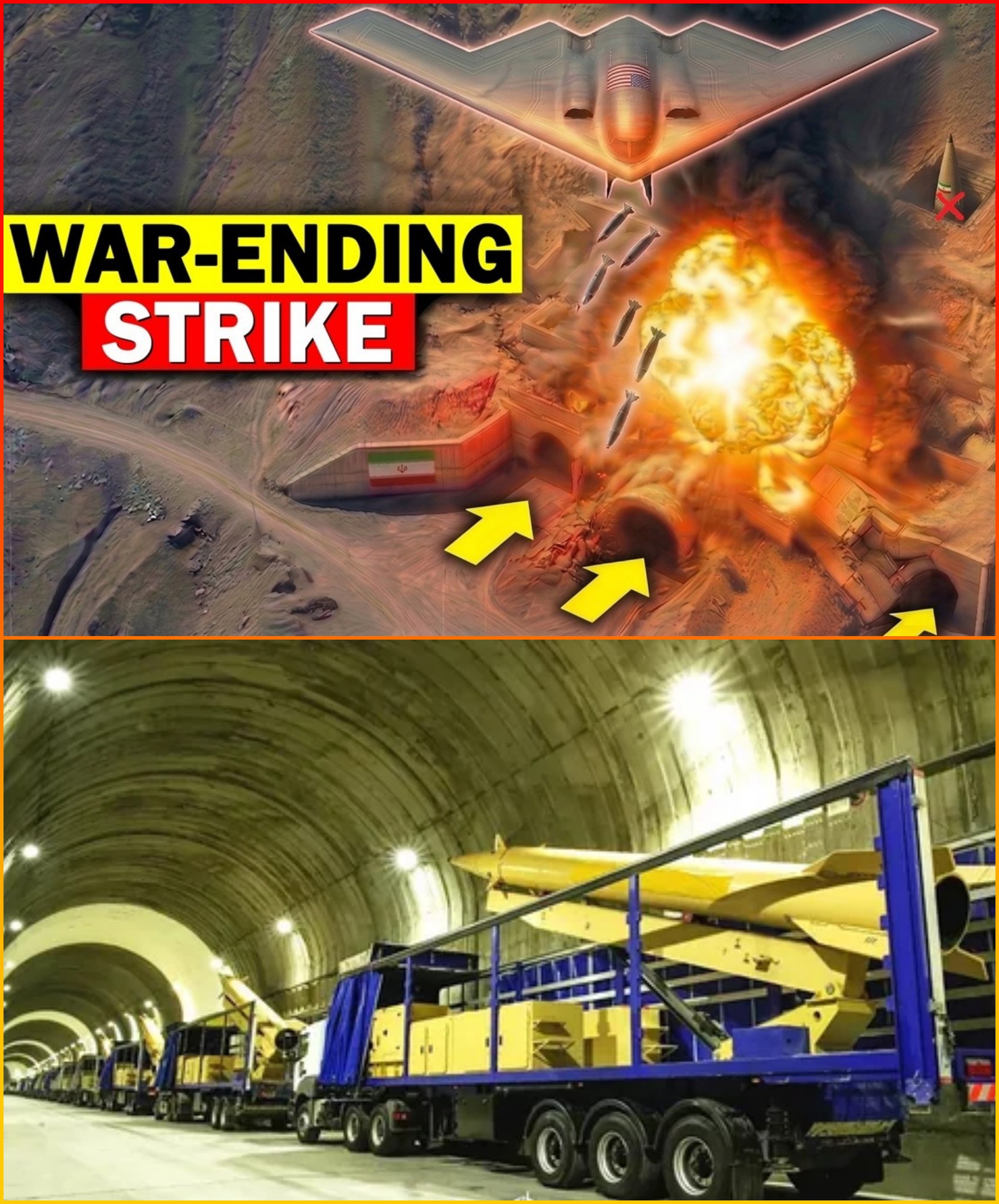
n a stunning turn of events, Iran’s long-standing strategic illusion has been shattered.
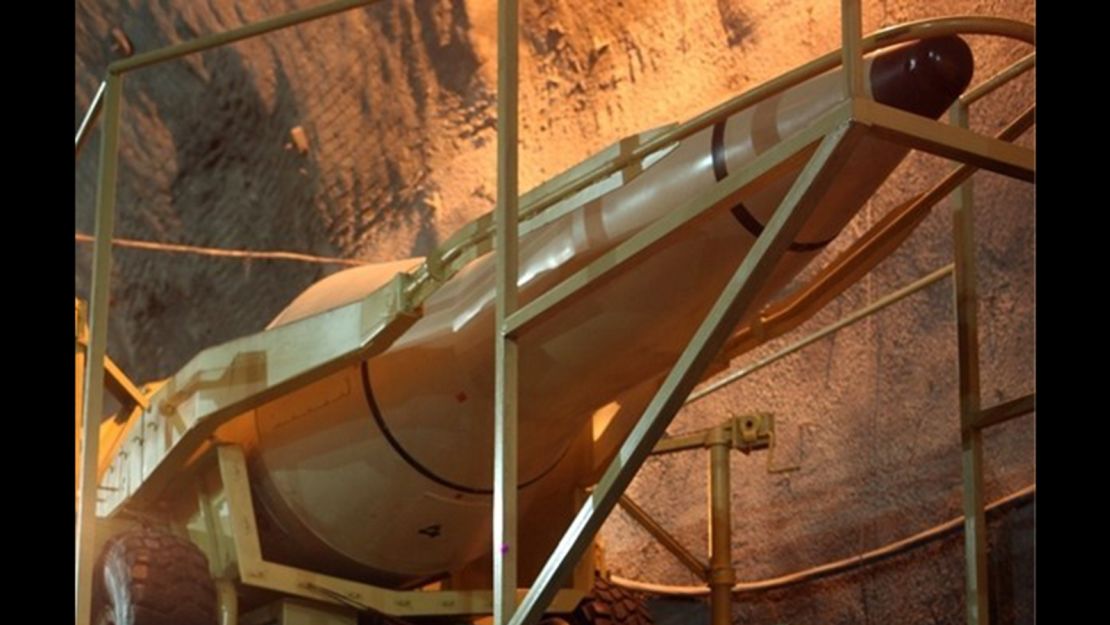
For years, Tehran invested heavily in constructing impenetrable underground missile cities and nuclear facilities deep beneath the mountains.
These fortifications were believed to be safe havens, designed to withstand the most sophisticated military assaults.
However, Operation Epic Fury has proven that no bunker can remain hidden from the might of American air supremacy.

In a devastating 72-hour blitz, U.S. B-2, B-1, and B-52 heavy strategic bombers executed precision strikes against Iran’s most heavily guarded secrets.
Utilizing massive 30,000-pound GBU-57 Massive Ordnance Penetrator (MOP) bunker busters and JDAM munitions, U.S. forces surgically targeted the critical vulnerabilities of these subterranean fortresses.
The result was catastrophic.
Facilities like Fordow and Isfahan were plunged into darkness and permanently sealed.
This military campaign has set a new precedent in modern warfare.
An estimated 80% to 90% of Iran’s strategic ballistic missile and drone stockpiles have been completely vaporized.
This dramatic depletion of military capacity hasn’t just crippled Tehran; it has severed the primary logistical artery for the entire “Axis of Resistance.”
From Hezbollah in Lebanon to the Houthis in Yemen, Iran’s proxy network has been left completely paralyzed.

The 72-Hour Blitz: Operation Epic Fury
Operation Epic Fury was not just another military operation; it was a calculated and decisive strike aimed at dismantling Iran’s military capabilities.
Over the course of 72 hours, U.S. forces executed a series of meticulously planned airstrikes that targeted key installations across Iran.
The operation showcased the effectiveness of American airpower and the advanced technology employed by the U.S. military.
With the B-2 stealth bomber leading the charge, the operation demonstrated the ability to penetrate deep into enemy territory undetected.
The use of GBU-57 bunker busters allowed U.S. forces to engage targets that were previously thought to be invulnerable.
These massive munitions are designed specifically to penetrate hardened targets, making them ideal for destroying underground facilities.
The precision of these strikes ensured that the damage inflicted was not only extensive but also irreversible.

The B-2 Stealth Bomber: Unleashing the Massive GBU-57 Bunker Busters
The B-2 stealth bomber has long been regarded as one of the most advanced aircraft in the world.
Its ability to evade radar detection makes it a formidable weapon in any military campaign.
During Operation Epic Fury, the B-2s played a crucial role in delivering the GBU-57 bunker busters to their intended targets.
These bombs, weighing in at 30,000 pounds, are designed to penetrate multiple layers of concrete and earth before detonating.
This capability allowed U.S. forces to effectively neutralize Iran’s underground missile cities.
The strategic use of the B-2s not only maximized the impact of the strikes but also minimized the risk to U.S. personnel.
By employing these advanced tactics, the U.S. military was able to achieve its objectives with remarkable efficiency.
Targeting the Tunnels: Surgically Destroying Ventilation and Entrances
The success of Operation Epic Fury was not solely due to the firepower of the B-2 bombers; it was also a result of the strategic targeting of Iran’s tunnel systems.
These tunnels were designed to provide secure access to Iran’s underground facilities and were critical to the operational effectiveness of its missile programs.
U.S. forces focused on obliterating surface entrances and vital ventilation systems, effectively sealing these tunnels and rendering them useless.
This surgical approach ensured that the strikes not only destroyed physical structures but also disrupted the operational capabilities of Iran’s military.
The loss of these facilities has left Iran vulnerable and has significantly weakened its ability to project power in the region.

90% Wiped Out: The Dramatic Collapse of Iran’s Missile Stockpiles
The aftermath of Operation Epic Fury has been nothing short of catastrophic for Iran.
With estimates suggesting that 80% to 90% of Iran’s strategic ballistic missile and drone stockpiles have been wiped out, the implications for regional security are profound.
This unprecedented loss has crippled Tehran’s military capacity and has raised questions about its ability to defend itself and its allies.
The destruction of these stockpiles has not only affected Iran but has also sent shockwaves through its proxy networks across the Middle East.
Axis of Resistance Paralyzed: How the Strikes Doomed Iran’s Proxy Forces
The impact of Operation Epic Fury extends beyond Iran’s borders.
The so-called “Axis of Resistance,” which includes militant groups such as Hezbollah and the Houthis, has been left reeling from the consequences of this military campaign.
With Iran’s missile capabilities severely diminished, these groups are now facing significant challenges in their operations.
The logistical support that Iran provided to these proxies has been severely compromised, leading to a paralysis of their military activities.
This shift in the balance of power in the region could have long-lasting effects on the dynamics of conflict in the Middle East.
Conclusion: The Future of Iran’s Military Capabilities
As we reflect on the implications of Operation Epic Fury, one question looms large: Is the Axis of Resistance permanently dead, or can Iran rebuild its underground cities?
The answer remains uncertain.
While the immediate effects of the operation have been devastating, history has shown that military capabilities can be rebuilt over time.
Iran may seek to adapt its strategies and fortifications in response to this setback.
The geopolitical landscape in the Middle East is constantly evolving, and the ramifications of this operation will likely be felt for years to come.
As analysts and military strategists assess the fallout from this campaign, the world watches closely to see how Iran will respond to this unprecedented challenge.
In the meantime, the U.S. has demonstrated its ability to project power and influence in the region, further solidifying its role as a key player in Middle Eastern geopolitics.
The future remains uncertain, but one thing is clear: the balance of power in the region has shifted dramatically, and the consequences of this shift will reverberate for years to come.