
Introduction: A Region on Edge
The Arabian Sea has recently become the focus of heightened international attention following conflicting reports of a potential military escalation involving major global powers and regional actors. According to statements circulating in Iranian state-affiliated media, a U.S. Navy aircraft carrier may have been targeted in a retaliatory missile operation. These claims, however, have been firmly rejected by U.S. defense authorities, who describe them as inaccurate and misleading.
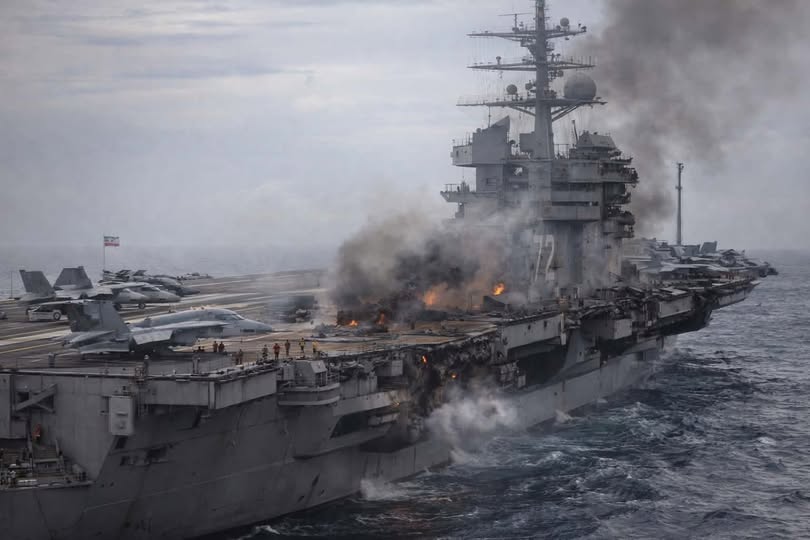
At the center of this unfolding situation is the USS Abraham Lincoln (CVN-72), a nuclear-powered aircraft carrier and one of the most significant assets in the United States Navy’s fleet. The vessel is widely regarded as a key component of American maritime power projection, capable of carrying out sustained air operations anywhere in the world.
While no independent verification has confirmed any damage or strike against the carrier, the competing narratives emerging from both sides have intensified diplomatic unease and triggered concern across global financial and energy markets.
Reports of a Missile Strike: Iranian Media Narrative
According to reports originating from sources linked to Iran, a series of ballistic missile launches were conducted in response to what Tehran described as hostile and unprovoked military activity in the region. These reports claim that the operation was intended as a retaliatory measure against coordinated actions involving U.S. and allied forces.
Iranian statements presented through state-aligned media outlets suggested that multiple missiles were launched toward a maritime target believed to be operating in or near the northern Arabian Sea. Some of these reports went further, claiming that at least one missile may have successfully reached its intended target area, allegedly striking or forcing evasive maneuvers by the carrier group.
These accounts also characterized the operation as a demonstration of domestic missile capabilities, emphasizing the scale and coordination of the launch. The messaging framed the alleged attack as a response to earlier military pressure in the region, portraying it as a defensive and deterrent action rather than an offensive escalation.
However, these claims have not been independently verified, and no third-party military or satellite assessment has confirmed any impact on naval assets in the region.
U.S. Military Response: Denial and Operational Continuity
In contrast to the Iranian narrative, U.S. defense officials have categorically denied that any successful strike occurred against the USS Abraham Lincoln or accompanying naval forces.
The U.S. Central Command (CENTCOM) issued a brief but firm statement rejecting the reports, stating that the carrier and its strike group remain fully operational and have not experienced any disruption. According to American military sources, any hostile projectiles launched in the region were either intercepted, failed during flight, or did not pose a credible threat to naval assets.
To reinforce this position, U.S. naval authorities released operational imagery and updates indicating that flight operations from the carrier continued as scheduled. These activities were presented as evidence that the vessel remained unaffected and capable of conducting normal missions.
American officials also characterized the circulating claims as part of a broader pattern of misinformation often associated with information warfare during periods of heightened regional tension. They urged caution in interpreting unverified reports and emphasized the importance of relying on confirmed intelligence assessments.
The Strategic Importance of Aircraft Carriers
The focus on the USS Abraham Lincoln reflects the broader strategic significance of aircraft carriers in modern naval doctrine. Such vessels are not merely warships but floating airbases capable of supporting sustained military operations far from home territory.
A carrier strike group typically includes destroyers, cruisers, submarines, and supply ships, all working together to provide protection and operational flexibility. The presence of such a group in a sensitive maritime region is often interpreted as a signal of deterrence and strategic commitment.
Because of their size, capability, and symbolic importance, aircraft carriers are often viewed as high-value assets in geopolitical calculations. Any credible threat to such a vessel would carry significant military and political implications, potentially signaling a major escalation in hostilities.
For this reason, even unverified reports involving carriers tend to generate substantial international attention and concern.
Operation Context: Regional Military Activity and Escalation Fears
The recent tensions are reportedly linked to a broader series of military developments in the region. Some accounts reference coordinated operations involving U.S. and allied forces aimed at degrading or disrupting hostile capabilities within strategic maritime corridors.
In response, Iranian officials have described their actions as defensive measures intended to counter perceived aggression. They have also suggested that missile operations were designed to demonstrate deterrence and military readiness.
This exchange of claims and counterclaims reflects a broader pattern of escalation in which both sides seek to project strength while avoiding direct confirmation of irreversible damage or loss.
Despite the intensity of rhetoric, there has been no independently confirmed evidence of large-scale destruction or sustained combat engagement at sea.
Information Warfare and Competing Narratives
One of the most notable aspects of this situation is the rapid spread of conflicting narratives across media platforms. In modern geopolitical conflicts, information itself often becomes a strategic tool, with different parties attempting to shape public perception and international response.
In this case, Iranian-affiliated outlets have emphasized the possibility of a successful strike or at least a symbolic military achievement. Meanwhile, U.S. sources have focused on operational continuity and denial of any impact, framing opposing reports as misinformation or psychological operations.
This type of narrative conflict is not unusual in high-tension environments, particularly when direct verification is limited due to restricted access to operational zones.
Analysts note that such information gaps can contribute to uncertainty, as global audiences attempt to interpret incomplete or contradictory data streams.
Global Economic Impact: Oil Markets and Maritime Risk
Even in the absence of confirmed military damage, the reports alone have had a noticeable impact on global financial markets. Energy traders, in particular, reacted quickly to the possibility of increased instability in the Arabian Sea and surrounding waterways.
The Strait of Hormuz, a narrow maritime passage critical to global oil transportation, remains a central point of concern. A significant portion of the world’s petroleum exports passes through this corridor, making it one of the most strategically important chokepoints in international trade.
Any perceived risk to shipping routes in this region tends to create immediate volatility in oil prices, as markets adjust to the possibility of supply disruptions. Following the emergence of conflicting reports, trading activity reflected increased uncertainty, with prices fluctuating as investors assessed potential escalation scenarios.
Governments in the broader region have also reportedly engaged in diplomatic discussions aimed at preventing miscalculations that could further destabilize maritime security.
Military Readiness and Regional Security Posture
In response to heightened tensions, naval forces operating in the region have reportedly increased surveillance and monitoring activities. Aircraft carrier groups, patrol vessels, and reconnaissance assets are typically placed on elevated alert during periods of uncertainty to ensure rapid response capability.
Such measures are generally precautionary in nature and do not necessarily indicate active conflict. Instead, they reflect standard military procedures designed to maintain readiness in volatile environments.
At the same time, regional governments have expressed concern about the possibility of unintended escalation, particularly in densely trafficked maritime zones where civilian shipping shares waterways with military operations.
Diplomatic Considerations and Calls for Restraint
International diplomatic channels have reportedly been active in response to the situation, with various actors encouraging restraint and de-escalation. The emphasis in these discussions has been on preventing misinterpretation of military movements and avoiding actions that could lead to broader conflict.
Diplomatic messaging has also focused on the importance of verifying claims before drawing conclusions, particularly in situations where misinformation or incomplete intelligence may distort public understanding.
While no formal resolution or agreement has been announced, there is continued emphasis on maintaining open communication channels between relevant parties.
Psychological and Strategic Dimensions
Beyond the physical military considerations, the situation also highlights the psychological dimensions of modern geopolitical confrontation. Claims of successful strikes, even when unverified, can serve strategic purposes such as deterrence, signaling capability, or influencing adversary decision-making.
Similarly, strong public denials and demonstrations of operational continuity are often intended to reassure allies, maintain domestic confidence, and counter opposing narratives.
This dynamic creates a complex environment in which perception and messaging can be nearly as important as physical events on the ground—or in this case, at sea.
Outlook: Uncertainty and the Path Forward
At present, the situation remains fluid, with no independently verified evidence confirming either a successful strike or any damage to naval assets. What is clear, however, is that the competing narratives have already influenced diplomatic discourse, military posture, and global market behavior.
The coming period will likely determine whether these reports fade as part of an information dispute or evolve into a more sustained phase of regional tension.
For now, naval forces continue their operations, governments remain in communication, and international observers are closely monitoring developments in one of the world’s most strategically sensitive maritime regions.
The broader question remains unresolved: whether this episode represents a temporary escalation in information-based conflict or an early signal of deeper geopolitical instability in the region.
Conclusion
The conflicting accounts surrounding alleged missile activity in the Arabian Sea highlight the complexity of modern geopolitical crises, where information, perception, and military signaling intersect. While one side reports a successful retaliatory strike and the other firmly denies any impact, independent verification remains absent.
What is certain is that such incidents—whether factual, exaggerated, or misinterpreted—can have immediate global consequences, influencing markets, diplomacy, and security planning.
As the situation develops, the international community continues to monitor closely, emphasizing restraint, verification, and dialogue as essential tools for preventing further escalation.