
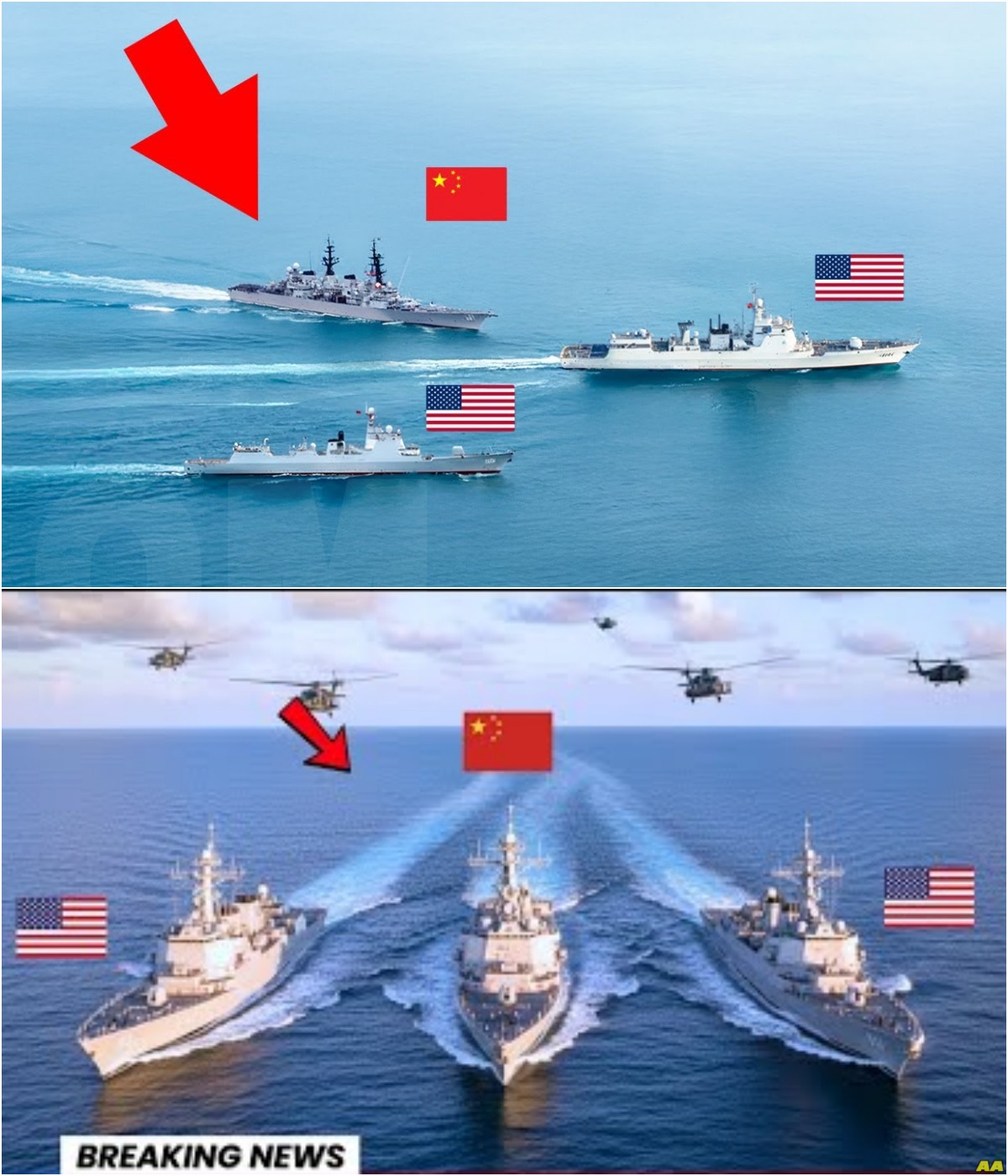
In the tense waters of the South China Sea, a seemingly routine naval operation escalated into a high-stakes confrontation that could have ignited a global conflict.
A Chinese destroyer received orders to intercept the USS Nimitz, one of the most formidable aircraft carriers in the world.
What followed was a dangerous game of brinkmanship, where both sides showcased their military prowess while teetering on the edge of war.
This incident serves as a stark reminder of the fragile balance of power in one of the world’s most contested regions.
The Context of Tension
The South China Sea has long been a hotspot for geopolitical tensions.
With multiple nations claiming territorial rights over its waters, including China, Vietnam, and the Philippines, the region is fraught with potential flashpoints.
The United States, committed to maintaining freedom of navigation and supporting its allies, regularly conducts naval operations in the area.
These operations often provoke reactions from China, which views them as challenges to its sovereignty.
The incident involving the USS Nimitz is just the latest example of this ongoing struggle for dominance.
The Players Involved
At the center of this confrontation was the USS Nimitz, a Nimitz-class aircraft carrier that represents the pinnacle of American naval power.
With a displacement of over 100,000 tons and a complement of around 6,000 personnel, the Nimitz is equipped with a wide array of advanced weaponry and aircraft.
Its presence in the South China Sea is a clear signal of U.S. commitment to regional stability.
On the other side, the Chinese destroyer, part of the People’s Liberation Army Navy (PLAN), was tasked with asserting China’s claims in the region.
Equipped with modern missile systems and radar capabilities, the destroyer was prepared to engage in a confrontation if necessary.

The Escalation
As the Chinese destroyer approached the USS Nimitz, tensions escalated rapidly.
Both vessels were on high alert, their crews aware that a single miscalculation could lead to disaster.
The destroyer closed in, entering what could be considered missile range, prompting the Nimitz to respond with unmatched speed and firepower.
Fighter jets were launched from the carrier, and the situation quickly evolved into a full-spectrum confrontation.
The Tactical Landscape
This incident was not just a display of naval might; it was a complex interplay of tactics and technology.
Both sides employed advanced weapons systems, including stealth submarines and electronic warfare capabilities.
The U.S. Navy utilized its airborne radar networks to monitor the situation closely, while the Chinese forces relied on their own sophisticated surveillance systems.
The tactical decisions made during these tense hours were crucial.
Each side sought to convey a message of strength without crossing the line into open conflict.

The Consequences of Miscalculation
In military operations, the margin for error is razor-thin.
One wrong move, one radar lock held too long, could lead to catastrophic consequences.
In this case, both the U.S. and Chinese forces understood the stakes.
They were engaged in a three-dimensional chess match, where each maneuver was calculated to assert dominance while avoiding escalation.
The potential for miscalculation loomed large.
A single missile launch or an accidental collision could have triggered a chain reaction, leading to widespread conflict.
Analyzing the Weapons Systems
Understanding the weapons systems involved in this confrontation is essential to grasping the magnitude of the situation.
The USS Nimitz is equipped with a variety of aircraft, including F/A-18 Super Hornets, which are capable of conducting air-to-air and air-to-ground operations.
These aircraft provide a significant tactical advantage, allowing the carrier to project power far beyond its immediate vicinity.
On the Chinese side, the destroyer boasted advanced missile systems designed to target enemy vessels and aircraft.
The J-15 fighters, launched from China’s newest aircraft carrier, added another layer of complexity to the situation, capable of engaging U.S. assets in the air.

The Role of Electronic Warfare
In modern military confrontations, electronic warfare plays a pivotal role.
Both the U.S. and China have invested heavily in technologies designed to disrupt enemy communications and radar systems.
During the confrontation, electronic warfare tactics were likely employed to gain an advantage, with both sides attempting to jam or deceive the other’s systems.
This aspect of modern warfare adds another layer of uncertainty, as the effectiveness of these tactics can significantly impact the outcome of engagements.
The Importance of Communication
In high-stakes military operations, clear communication is paramount.
Misunderstandings can lead to unintended escalations, making it vital for both sides to convey their intentions accurately.
In this incident, both the U.S. Navy and the Chinese forces had to navigate the delicate balance of signaling strength while avoiding provocations.
The presence of military attachés and communication channels between the two nations may have played a crucial role in preventing the situation from spiraling out of control.
A Cinematic Breakdown
As we analyze this incident, it becomes clear that it resembles a cinematic thriller, filled with tension and uncertainty.
The stakes were incredibly high, with the potential for a global conflict hanging in the balance.
Military analysts and experts have likened such confrontations to a game of poker, where each side must carefully consider its next move.
In this case, both the U.S. and China demonstrated their resolve while avoiding a direct confrontation, showcasing their military capabilities without crossing the line into open warfare.
The Aftermath and Future Implications
In the aftermath of this confrontation, the implications for U.S.-China relations are profound.
Such incidents highlight the need for continued dialogue and diplomacy to manage tensions in the region.
The potential for conflict remains ever-present, and both nations must work to establish protocols to prevent future escalations.
Additionally, this incident serves as a reminder to other nations in the region about the potential consequences of aggressive posturing.
The South China Sea will continue to be a focal point for geopolitical tensions, and all parties involved must tread carefully.
Conclusion
The confrontation between the Chinese destroyer and the USS Nimitz was a close call that could have had dire consequences.
It underscores the delicate balance of power in the South China Sea and the importance of maintaining open lines of communication.
As both nations continue to navigate this complex landscape, the lessons learned from this incident will be crucial in shaping future interactions.
In a world where the risk of conflict is ever-present, understanding the dynamics of military confrontations is essential.
This incident serves as a powerful reminder of the stakes involved and the need for careful diplomacy in a rapidly changing geopolitical landscape.
The next chapter in U.S.-China relations remains unwritten, but one thing is clear: the world is watching closely.