
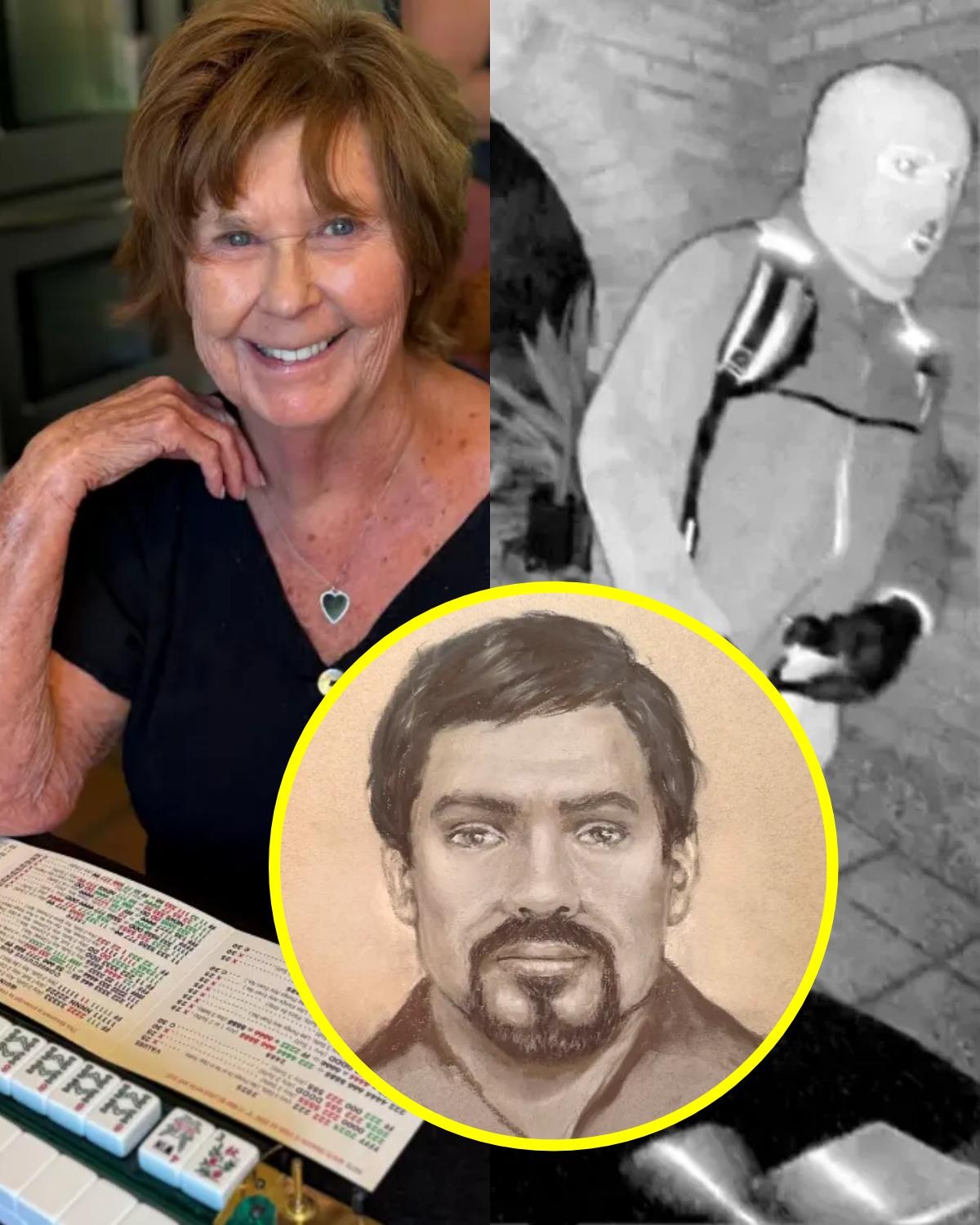
A new image is taking shape in the Nancy Guthrie investigation—one drawn not by law enforcement, but by a veteran forensic artist working from the same haunting surveillance footage the public has been replaying for days. It’s the kind of development that can jolt a case forward, or simply add another layer of noise to an already crowded tip line. Either way, it’s emotional fuel: a face where there wasn’t one before, and the uneasy hope that someone, somewhere, will recognize what the mask tried to hide.
A Face From the Shadows: A Forensic Artist Steps Into the Guthrie Case
For nearly two weeks, the most unsettling image in the Nancy Guthrie case has been the same: a masked man at a front door, caught by a home camera, moving with a purpose that feels both blunt and calculated.
The footage—grainy, limited, and terrifying in its ordinariness—doesn’t offer the clean visual certainty people crave. There is no clear face. No crisp ID. No instant recognition. Just fragments: eyes, posture, the impression of a weapon, the claustrophobic sense that a crime can begin in the same space where packages get delivered and neighbors wave hello.
Now, someone has tried to do what the camera could not.
A forensic artist in Houston, Lois Gibson, has released what she describes as the first sketch that attempts to predict what the suspect might look like beneath the mask. She is widely known by the title she’s been associated with publicly—“The World’s Most Successful Forensic Artist”—and she has joined what she calls the effort to help bring Nancy Guthrie home.
It is, in a way, a new chapter in the same story: the public looking at a partial image and trying to complete it.
And it’s also a reminder of what this case has become: not only a search for a missing woman, but a race between time and uncertainty—between what can be proven and what can only be inferred.
Gibson makes a sketch.
Who Is Lois Gibson—and Why Her Sketch Is Getting Attention
Gibson’s name carries weight in the true-crime world, and she leans into that reputation in her public defense. According to the information in your text, her work has helped apprehend more than 750 criminals, and she holds a world record title associated with her success as a forensic artist.
That kind of résumé is exactly why her sketch is spreading.
When an investigation feels stalled—no arrests, few official details released—people are hungry for anything that looks like progress. A sketch offers something concrete, even when it’s built from incomplete material. It gives the brain a handle: a head shape, eyebrows, hair, facial hair—human features that feel easier to recognize than a masked figure lit by a doorbell camera.
Gibson says she produced the image after reviewing the surveillance photos that show the masked suspect around Guthrie’s home. Her sketch, as she describes it, depicts an abductor with:
– a wide head
– thick eyebrows
– medium-length, dark hair
– a goatee
It’s the first attempt—at least in the public arena—to translate the few uncovered features into a full face.
But Gibson is unusually blunt about what this sketch is and what it is not.
She says she “guessed” the parts of the face covered by the ski mask, warning that only certain areas are “somewhat sure,” specifically:
– the eyes
– part of the lips / mustache
“I’ll take the hit if I’m drastically wrong,” she added, emphasizing the uncertainty built into the process.
That line matters. It signals a rare kind of honesty in a moment when the public often treats any image as if it were evidence. Gibson is presenting her work not as certainty, but as an attempt—an interpretive tool meant to trigger recognition.
A sketch is not an ID. It’s a prompt.
And in this case, the prompt arrives when people are desperate for anything that narrows the field.
A newly released photo February 10, 2026 shows a masked suspect outside the Arizona home of 84-year-old Nancy Guthrie on the night she was abducted.
The Surveillance Footage: A Mask, a Door, and a Thousand Theories
The core visual in the case remains the same: doorbell video showing a masked suspect at Nancy Guthrie’s home.
Authorities have released that footage, according to your text, in hopes of reaching someone who might recognize the suspect based on the limited visible features—what the mask didn’t cover, what the camera managed to capture.
That strategy—releasing partial video to the public—is a balancing act. It can generate tips at scale, but it also generates chaos: guesses, lookalike accusations, false certainty, and sometimes collateral damage for innocent people who resemble a vague silhouette.
Yet investigators often do it because they know something else too: someone out there may recognize the walk, the body language, the eyes, the build—details that don’t always register as “evidence” until a person who truly knows the suspect sees them.
The footage, as described, depicts the suspect heavily masked and armed, “lurking” at the front door. The mood of the case—its “disturbing” quality—comes from how intimate that image feels. This is not a crime scene in a distant alley. It’s a home. A threshold. A place associated with safety.
And the mask does its job: it turns a person into an outline. A presence without an identity.
That is the psychological space Gibson is trying to interrupt—by turning the outline back into a face.
Nancy smiles in a photo.
What Authorities Have Officially Said About the Suspect
While Gibson’s sketch is spreading online, law enforcement has stuck to a simpler, more defensible description.
Authorities have said the suspect is:
– Male
– Approximately 5’9” to 5’10”
– Average build
That is the description attributed to federal authorities in your text, and it matches the kind of cautious framing investigators use when they don’t want to over-commit to details that might later prove wrong.
Notably, your content also states police have not released their own sketch. So Gibson’s image is filling a vacuum—publicly, at least.
That vacuum is powerful. It doesn’t mean investigators have nothing. It means they’re not showing the public everything they have, which is common in kidnapping cases where evidence integrity matters.
But for the public, silence doesn’t feel strategic. It feels like nothing is happening.
That’s when unofficial visuals begin to take on outsized power.
—
The Promise and the Risk of an Unofficial Sketch
A forensic sketch can be a breakthrough in the right context—especially if it triggers a memory in someone on the suspect’s social perimeter.
It can also misfire spectacularly.
Gibson herself acknowledges this tension by repeatedly emphasizing guesswork. She is, in effect, warning people not to treat her sketch like a photograph.
Still, the risks are unavoidable:
Why it can help
– It turns an abstract suspect into a recognizable pattern.
– It can jog a witness’s memory (“Those eyebrows… that hair… that goatee…”).
– It gives tipsters a clearer reference than a masked face.
Why it can harm
– It can send tips flooding in based on resemblance alone.
– It can fuel online vigilantism and misidentification.
– It can distract from more reliable leads if the public becomes fixated.
This is why law enforcement typically controls sketches tightly: they want to manage accuracy, avoid contamination of witness memory, and prevent people from shaping their recollection around a published face.
Gibson has received criticism for releasing a sketch before law enforcement authorized one, according to your text. Her response is not apologetic. It’s defiant—and emotional.
—
Gibson’s Response to Critics: “I Did This in an Effort to Help”
Gibson’s public defense is intensely personal.
She says “pompous critics” call her unethical, claiming they have higher professionalism. She dismisses that critique and points instead to her reputation and prior work.
In her statement, she references a prior case in which she drew a sketch of an abuse victim based solely on the girl’s skull, and the victim’s mother recognized the image as her missing daughter.
She also states:
– Her sketches have retrieved eight kidnap victims, including four infants
– She has been with loved ones in agony, describing kidnapping as “the worst emotional torture imaginable”
– She did the sketch “in an effort to help”
Whether one agrees with her decision or not, that framing reveals something important about this moment: it’s not only investigators who are emotionally invested. This case has become a public trauma, and people who believe they can contribute are stepping forward—sometimes in ways that collide with investigative protocol.
Gibson’s stance is essentially this: even if the sketch is imperfect, the possibility of recognition is worth the risk.
The counterargument—unspoken but obvious—is that imperfect visuals can burn time, mislead the public, and muddy the waters.
Both can be true.
And in a case with no arrests, the tension between action and accuracy becomes painfully visible.
—
The Case Status: No Arrests, Detainments, and a Tip-Driven Search
As of Saturday, according to your text, there have still been no arrests.
That fact hangs over every update like a ceiling.
There have been detainments, including one that drew significant attention:
– A delivery driver in Tucson was questioned after a family member told police his eyes matched those of the suspect.
– The driver was ultimately released.
The release matters because it illustrates how quickly “recognition” can turn into a dead end. It also highlights how unreliable partial features can be—especially something as common and variable as eyes, seen through the distortions of camera footage and human fear.
More recently, your text states:
– Four people were detained in overnight operations Friday (including a mother-son duo)
– All were released after interviews
And investigators are described as mostly relying on hotline tips.
That detail—tip reliance—can mean two things at once:
- The public has been given enough to recognize something.
- The case is still searching for the one tip that isn’t just noise.
When tips pour in, investigators must triage: sorting credible leads from misidentifications, rumors, and well-intentioned but irrelevant sightings. It’s exhausting work—often invisible to the public—because it produces more “not this” than “this.”
That’s the quiet reality behind viral developments like an unofficial sketch: it may help, but it may also multiply the workload.
—
A Key Forensic Development: Unidentified DNA Recovered
One of the most consequential details in your text is forensic: investigators recovered DNA evidence from someone not known to be “in close” contact with Guthrie, taken from her property.
That DNA has been sent to a laboratory for analysis.
This is the kind of update that can be pivotal—but only later.
DNA is not a suspect by itself. It’s a question in biological form:
– Who does it belong to?
– How did it get there?
– Does it connect to the crime—or to ordinary life around the property?
The phrase “not known to be in close contact” suggests investigators have already accounted for a set of people who should reasonably be present in that environment, and the DNA falls outside that group. That can be significant. It can also be complicated.
Still, compared to sketches and video impressions, DNA has a different power: it can move from possibility to match, from narrative to evidence—if it hits against someone in a database or a known individual.
Right now, based on your content, we only know two things:
– the DNA is unidentified
– it is being analyzed
Everything else remains in motion.
—
The Disappearance Timeline: Last Seen Jan. 31, Reported Missing the Next Day
Your text states Nancy Guthrie was last seen alive on Jan. 31 and was reported missing the following day when she failed to show up to watch a church service being streamed at a friend’s house.
That detail is piercing because it’s ordinary. Not showing up for something small—something familiar—often becomes the first clear sign to others that something is wrong.
It’s how disappearances often announce themselves: through broken routine, not through dramatic alarms.
Your content also states she was apparently forcibly removed from the house, leaving a trail of blood behind.
That fact sets the tone investigators are operating under: this is not being treated as a voluntary absence. It is being framed as violent, urgent, and criminal.
And it heightens the emotional stakes of every new development—because the question is not only “Where is she?” but “Is she safe?” and “How much time is left?”
—
Ransom Notes and Reward Money: Pressure on the Perimeter
Your text notes that multiple ransom notes have surfaced since she vanished, allegedly from self-proclaimed kidnappers. Details are limited, but the existence of ransom communications—if authentic—adds a psychological layer to the case: someone not only took a person, but attempted to control the narrative afterward.
In response, federal authorities have doubled the reward to $100,000 for information leading to Guthrie or her captor.
Rewards serve two audiences:
– The public at large—encouraging anyone with minor information to come forward
– The suspect’s circle—creating financial incentive strong enough to break loyalty, fear, or silence
A $100,000 figure is substantial enough to change decisions. It can prompt an acquaintance to reconsider what they “don’t want to get involved in.” It can push someone who knows a detail to finally speak.
But again, it also amplifies the tip flood. Investigators must weigh each lead quickly and carefully.
In a case where time matters, reward-driven tips can be both lifeline and avalanche.
—
Why a Sketch Feels So Powerful Right Now
If law enforcement has not released an official sketch, and the public is left with masked footage, the emotional gap is enormous.
People want:
– a face to search for
– a person to imagine
– a singular villain to locate and stop
A mask denies that satisfaction. It keeps the suspect abstract—harder to picture, harder to recognize, harder to report with confidence.
Gibson’s sketch does something psychologically soothing, even if it isn’t technically definitive: it gives the public a face-shaped container for fear.
It says: look here, not everywhere.
That’s why it spreads. Not necessarily because it’s accurate—but because it feels like the kind of tool a case should have.
And yet, Gibson’s own caveats remain the most responsible part of the entire development: she guessed at covered features, and only the visible fragments are “somewhat sure.”
The eyes. Part of the lips. The mustache.
In other words: the sketch is an educated extrapolation, not a forensic fact.
—
The Investigation’s Reality: Progress Often Looks Like Frustration
This case, as described in your content, has a rhythm that’s common in high-profile abductions:
– A disturbing video release
– A surge of tips
– A detainment
– A release
– Another operation
– More detainments
– More releases
– A forensic development that may take time to process
– A reward increase to keep pressure high
From the outside, it can feel like nothing is happening—because there is no arrest to point to.
From the inside, it can feel like everything is happening—because investigators are trying to build a chain strong enough to hold in court, not just in public opinion.
And that distinction is crucial. Public certainty is not legal certainty. Viral recognition is not probable cause. A sketch is not a match.
The case will not turn on what trends. It will turn on what holds.
If the DNA connects, it could be pivotal. If a tip aligns with evidence, it could be pivotal. If someone recognizes the suspect from the footage in a way that can be corroborated, it could be pivotal.
But until then, the case sits in that grueling middle state: urgent, emotional, and unresolved.
—
Where This Leaves the Public Right Now
Based strictly on the information you provided, here is the present landscape:
– A masked suspect appears in released doorbell footage.
– Authorities describe the suspect as a male, about 5’9”–5’10”, average build.
– Lois Gibson released an unofficial sketch based on surveillance images, describing wide head, thick eyebrows, medium dark hair, and a goatee—while warning much of it is guessed.
– There have been detainments (including a delivery driver and four people in an overnight operation), but no arrests, and those questioned were released.
– Investigators recovered unidentified DNA from the property, from someone not known to be in close contact, sent for lab analysis.
– Multiple ransom notes have surfaced.
– The FBI doubled the reward to $100,000 for information leading to Guthrie or her captor.
That combination—public imagery, forensic analysis underway, tips pouring in—is a classic pressure cooker.
And it explains why a sketch matters emotionally: it feels like a step toward turning a shadow into a suspect.
Whether it becomes a step toward an arrest is something only the evidence—and time—can answer.
Spotted at Last: Savannah Guthrie’s Husband Escorted Through Airport With Kids as Nancy Search Intensifies