
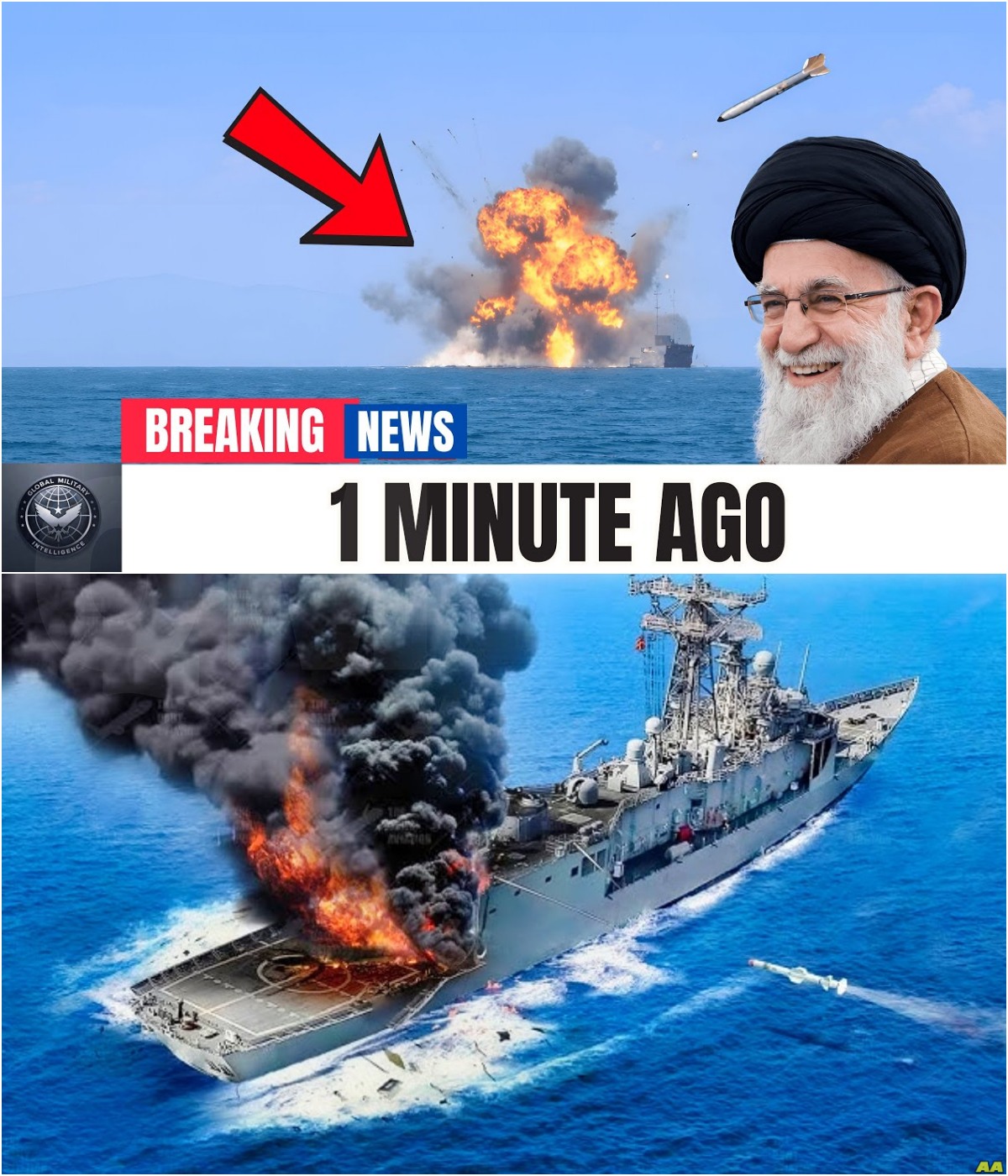
In the narrow waters of the Strait of Hormuz, a tense standoff unfolded.
Iran believed it had devised the perfect ambush.
Thirty-two anti-ship missiles were poised for launch, aimed directly at a U.S. aircraft carrier.
With four thousand seven hundred lives on the line and only three minutes and forty seconds to impact, the stakes could not have been higher.
This scenario, while fictional, serves as a striking reminder of the complexities and dangers of modern naval warfare.
As we delve into this high-intensity military analysis, we explore how layered missile defense, electronic warfare, and overwhelming retaliation can transform a carefully planned strike into a total strategic collapse in just thirty-two minutes.

The Setting: A Volatile Region
The Strait of Hormuz is a critical chokepoint through which a significant portion of the world’s oil supply passes.
Its strategic importance cannot be overstated, making it a hotspot for geopolitical tensions.
In this scenario, Iran’s military strategy was predicated on the belief that a surprise attack could yield a decisive victory against a formidable adversary.
However, as history has shown, engaging a U.S. Navy carrier strike group is not merely about launching missiles; it is about understanding the broader implications of such an action.
The Attack: A Coordinated Saturation Strike
Imagine the scene: Iranian coastal missile batteries, hidden from radar, prepare for a coordinated saturation attack.
The missiles are equipped with advanced guidance systems, designed to evade detection and overwhelm defenses.
As the countdown begins, the tension is palpable.
The first missiles are launched, streaking across the sky toward their target.
But what happens next is where the narrative shifts dramatically.

The Defense: Layers of Protection
The U.S. Navy, renowned for its technological prowess, is not caught off guard.
Layered missile defense systems are activated.
Aegis destroyers, equipped with advanced radar and interceptor missiles, spring into action.
The timeline for interception is crucial.
Within seconds, the first missiles are detected, and the U.S. Navy’s response is immediate.
Interceptor missiles are launched to intercept the incoming threat, showcasing the effectiveness of modern missile defense technology.
Electronic Warfare: The Invisible Battlefield
In the chaos of the attack, electronic warfare plays a pivotal role.
Iranian forces attempt to jam communications and radar systems, hoping to blind their adversary.
However, the U.S. Navy employs its own electronic warfare tactics, countering these efforts and maintaining situational awareness.
This invisible battle in the electromagnetic spectrum is just as critical as the physical confrontation taking place in the skies.

The Counterstrike: Tomahawk Missiles in Action
As the Iranian missiles are intercepted, the U.S. Navy prepares its counterstrike.
Tomahawk cruise missiles, launched from submarines and surface ships, are deployed with precision.
These missiles are capable of striking high-value targets deep within enemy territory, showcasing the U.S. military’s ability to project power globally.
The response is swift and overwhelming, illustrating the principle that in modern warfare, the first shot rarely decides the outcome — it is the response that truly matters.
The Aftermath: Strategic Collapse
In this fictional scenario, the Iranian forces face a strategic collapse within thirty-two minutes of initiating their attack.
The coordinated defense and counterstrike lead to significant losses for Iran, demonstrating the consequences of underestimating an adversary’s capabilities.
As the dust settles, the lessons learned are profound.
Engaging a U.S. aircraft carrier strike group is not just a military operation; it is a complex interplay of strategy, technology, and decision-making.
The Broader Implications: Understanding Modern Warfare
This analysis sheds light on the dynamics of modern naval warfare.
It emphasizes the importance of preparedness, technological superiority, and the ability to respond effectively to threats.
In a world where conflicts can escalate rapidly, understanding these principles is vital for military planners and policymakers alike.
Conclusion: A Cautionary Tale
While this scenario is fictional, it serves as a cautionary tale about the realities of modern warfare.
The events described are not merely hypothetical; they reflect the strategic decision-making processes that shape military actions in the real world.
As tensions continue to simmer in regions like the Strait of Hormuz, the lessons from this analysis remain relevant.
In the end, the question is not merely who fires the first shot, but who can effectively respond and adapt to the rapidly changing battlefield.
This narrative, while dramatic, underscores the complexities of military engagement in the 21st century.
As we reflect on these scenarios, we must remember that the stakes are high, and the consequences of failure can be catastrophic.
In modern naval warfare, the countdown is always on.
Disclaimer: This content is a fictional scenario created for educational, analytical, and storytelling purposes only.
The events, timelines, characters, military actions, and outcomes described in this article do not represent real historical events and should not be interpreted as factual reporting, intelligence information, or official military records.
This narrative is based on hypothetical situations, publicly known military concepts, and speculative analysis, presented in a dramatic format to help readers understand strategic decision-making, escalation dynamics, and modern warfare doctrines.
This content does not promote violence, hatred, or conflict against any nation, military, or group.
It does not reflect the views or positions of any government, armed force, or organization.
Any similarities to real events, locations, or individuals are coincidental and used solely for illustrative purposes.
Reader discretion is advised.