
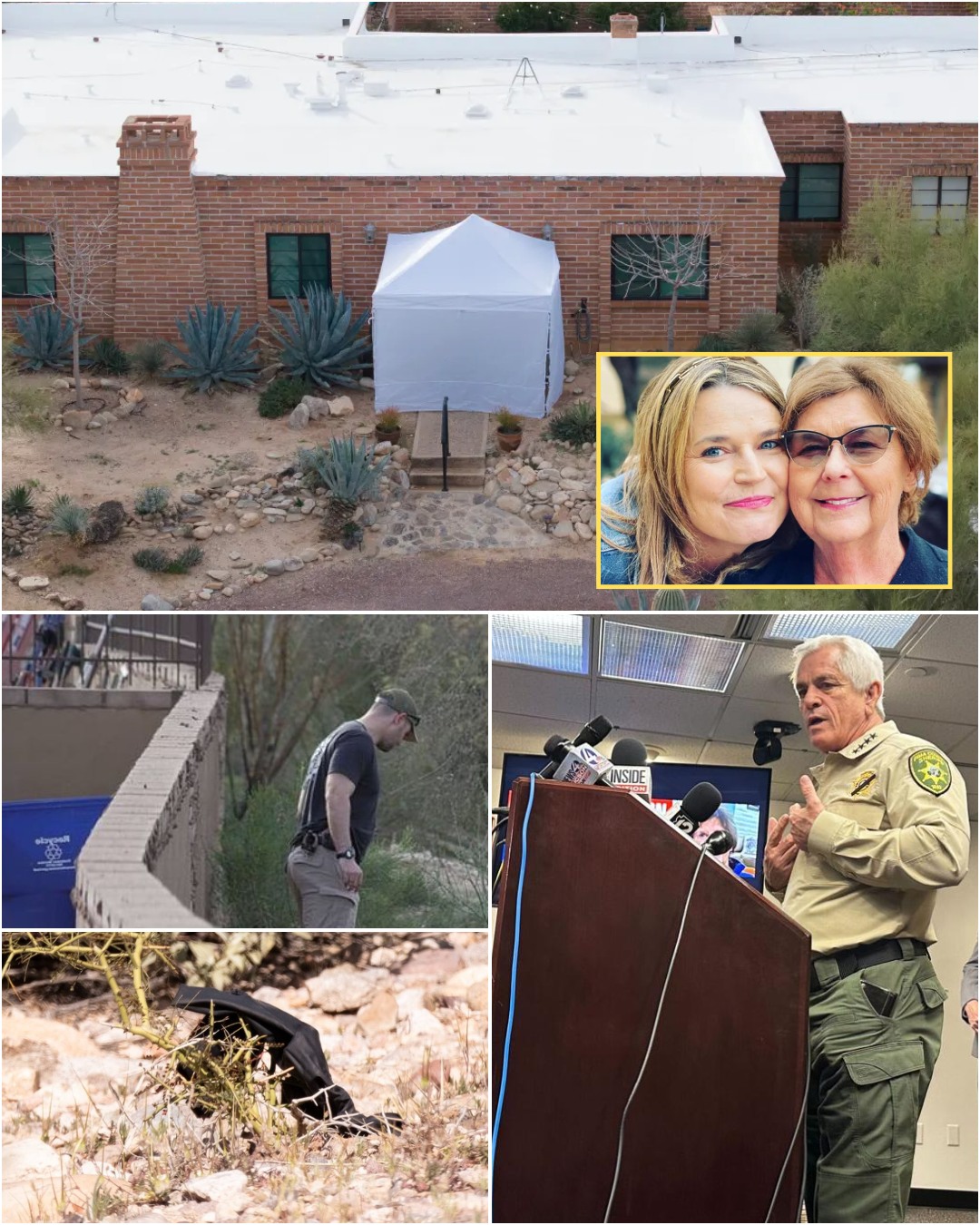
Blood On The Porch, An Empty Doorway, And A Secret In The Lab
It is late Sunday morning in the Arizona desert. The sun is already bright over the Catalina Foothills, just north of Tucson.
A friend is waiting for 84‑year‑old Nancy Guthrie to appear on a live‑streamed church service the way she always does. She waits once. She checks again. A third time, there is still no sign of Nancy. That is when worry turns into fear.
By just before noon, Nancy’s family is standing at the front door of her single‑story home. Her car is in the garage. Her purse, phone, hearing aids, and daily pillbox are all inside. Her walker is there. Her Bible is there. But Nancy is not.
On the front porch, near the base of the steps, deputies notice something else. Small stains, dark against the concrete. Later tests will confirm it: the blood belongs to Nancy Guthrie.
Above the front door, there is an empty mount where a doorbell camera is supposed to be. The device is gone.
Hours later, in a quiet forensic lab, technicians swab surfaces from the entryway and inside the house. They expect to find Nancy’s DNA. They do. But soon, they find something else—a second DNA profile.
It does not belong to Nancy. It does not match anyone “closely associated with her.”
In a house where an 84‑year‑old woman lived alone, there is now proof that a stranger has been there.
Who Is Nancy Guthrie?
To millions of Americans, the name “Guthrie” means Savannah—the warm, familiar face on NBC’s “Today” show. To three grown children, it means their mother, Nancy Ellen Guthrie. To the people at her church in Arizona, it means a soft‑spoken woman who shows up faithfully, who prays, who remembers birthdays and illnesses and small kindnesses.
Nancy is 84. She is a widow, a mother, and a grandmother. She lives alone in a tidy home in the Catalina Foothills, an unincorporated community just north of Tucson, with desert scrub and mountain views.
She has health issues typical of her age. She needs daily medications. She has a pacemaker that sends data through her phone. She uses hearing aids. Her routine is simple and predictable: family dinners, church, calls and messages with her children, quiet evenings at home.
This is not a woman who wanders off. Not a woman likely to disappear into the night without her car, her phone, or her medication.
Sheriff Chris Nanos of Pima County will say it plainly within days: he does not believe she left on her own. He believes she was taken.
The Last Normal Night
Saturday, January 31, 2026, begins like a hundred other days.
Around 5:30 p.m., Nancy orders an Uber to go to dinner at the home of her older daughter, Annie. She spends hours there—dinner, games, conversation—with family, including her son‑in‑law, Tommaso Cioni. There is nothing unusual, nothing ominous.
Sometime around 9:48 p.m., Tommaso drives Nancy back to her home. A garage‑door camera records her arriving. The door goes up. A few minutes later, it goes down.
He watches to be sure she is safely inside. That is the last time any member of her family will see her.
Inside the house, Nancy likely changes into something comfortable, puts away her purse, sets her hearing aids down in their usual spot. Maybe she glances at her phone. Maybe she thinks about the church service she will attend—virtually—the next day.
Nothing about that moment suggests that in just a few hours, someone else will be at her door.
The Night Of: A Camera Goes Dark
The desert is quiet after midnight. Coyotes sometimes call. The wind moves through the cacti. Most of Nancy’s neighbors are asleep.
At 1:47 a.m., something happens at Nancy’s front door. Her internet‑connected doorbell camera is disconnected.
The system logs the time. First event.
About 25 minutes later, around 2:12 a.m., another camera on her property detects motion. Because the family did not upgrade a subscription, the system notes movement but does not save any video.
Second event. Movement, but no picture.
At 2:28 a.m., Nancy’s pacemaker loses connection to her cellphone. Her phone remains inside the house.
Third event. The device that monitors her heart suddenly stops sending signals.
Those three time stamps—1:47, a little after 2:00, and 2:28 a.m.—will become the skeleton of the case. Investigators will circle back to them again and again.
Somewhere inside that half‑hour window, someone reaches Nancy’s door. Someone disables or removes the camera. Someone enters the home of an 84‑year‑old woman.
Nancy does not walk back out on her own.
Sunday Morning: When Worry Turns To Panic
On Sunday, February 1, a friend expects Nancy to show up, as always, for a live‑streamed church service. The time comes. No Nancy.
The friend waits, thinking maybe Nancy is late. She checks again. Still no Nancy. The third time, she reaches out to Nancy’s family.
Savannah and her siblings know their mother’s habits. She does not just skip church. She does not let her phone die. She does not go anywhere without telling anyone, especially not without her medications or her car.
Around 11:56 a.m., family arrive at Nancy’s house in the Catalina Foothills. They find the garage closed. Inside: Nancy’s car.
They go inside the house. They find her wallet. Her cellphone. Her hearing aids. Her daily pill organizer. Her walker. Her glasses. Everything that says “an elderly woman lives here” is in its usual place—except for the woman herself.
They step back outside. That is when the blood on the porch catches their eye. Small spatters, easy to miss, impossible to ignore once you see them. Close by, they notice the empty space where the doorbell camera used to be.
At 12:03 p.m., they call 911.
In the hours that follow, deputies canvass the property. Drones and search dogs are deployed. Search and rescue teams comb the area by air and ground.
At first, some might wonder: Did Nancy get confused and walk away? Did she fall somewhere nearby?
But what happens next will change everything.
From Missing Person To Possible Kidnapping
Within about a day, the tone from law enforcement shifts.
By Monday morning, February 2, the Pima County Sheriff’s Department publicly says what the evidence is already suggesting: they believe Nancy may have been kidnapped, abducted, or otherwise taken from her home against her will.
Sheriff Nanos says he believes a crime has been committed, that she did not leave voluntarily. Her age, her health, the blood on the porch, the missing security camera—all of it points in one direction.
The Arizona Department of Public Safety issues an alert. All of Nancy’s personal belongings, including her car and phone, are still at the house.
The investigation quickly grows. Local deputies coordinate with the FBI. A reward is offered—initially $50,000—for information leading to Nancy’s recovery.
Soon, the case catches national attention. Not just because an elderly woman is missing—but because she is the mother of one of the country’s most recognizable morning‑show anchors.
President Donald Trump calls the situation “terrible” from the Oval Office and says federal authorities are involved. Savannah thanks the public for prayers and pleads for help in finding her mother.
This is no longer just a local missing‑person case. It has become a national story—and, for investigators, a race against time.
The First Clue From The Lab: Blood
Back at the lab, the first tests are straightforward. Technicians swab the blood from Nancy’s porch. They run it through standard analysis.
The DNA profile matches Nancy. It is her blood.
That single fact pushes the case toward violence. An 84‑year‑old woman bleeding at her own front door—then vanishing—is not a sign of a gentle departure.
But blood is only the beginning. Technicians also collect other samples. Touch points on doors. Railings. Floors. Items near the entry. In modern forensics, even a few skin cells can be enough to build a DNA profile.
When the results come back, they confirm what everyone expects to see: Nancy’s DNA on items she uses.
Then comes the surprise.
They detect a second DNA profile. It does not belong to Nancy. It does not match anyone “closely associated with her”—a phrase law enforcement uses for immediate family and others regularly in her orbit.
In an 84‑year‑old woman’s home, where she lives alone, DNA is like a guest book. Hers should be everywhere. Other people’s should be rare and explainable.
Here, there is a signature from someone who is not supposed to be there.
The Stranger’s DNA
Investigators do not immediately reveal the discovery. During the first week, they confirm only that the blood belongs to Nancy and that her home is being treated as a crime scene.
But as the second week begins, Sheriff Nanos discloses a crucial detail: they have found DNA at the property that is not Nancy’s and does not match anyone close to her.
He also notes that law enforcement has collected items from near the home, including a pair of gloves found about two miles away, which are being tested for DNA.
For the public, this is a chilling update. It means at least one unknown person was in or around Nancy’s home close to the time she disappeared.
For investigators, it is both a blessing and a burden. DNA is powerful, but only if there is something to match it to.
If the stranger’s DNA already exists in a law‑enforcement database—because the person has been arrested, convicted, or otherwise sampled—then a hit can come quickly. If it does not, the profile becomes a ghost. A set of numbers with no name.
Sheriff Nanos hints that the DNA found at the scene does not currently match anyone in their known circle. That strongly suggests it also has not popped up as a simple, immediate hit in federal databases like CODIS, at least not yet.
So investigators begin the slow, methodical work that rarely makes headlines:
They ask which repair workers have been in the house.
They ask which visitors came recently.
They ask neighbors about any stranger at the door.
One by one, they try to clear people by collecting voluntary DNA samples and comparing them to the unknown profile.
The stranger’s DNA becomes a silent character in the story. Invisible, but central.
The Doorbell Video: A Masked Man At The Threshold
For days, people ask the same question: If the doorbell camera was missing, how can there be footage?
The answer comes on February 10. The FBI and Pima County Sheriff’s Department release grainy black‑and‑white images and short video clips of an “armed individual” at Nancy’s front door in the early hours of February 1.
The footage—recovered with help from “private sector partners” after initially being lost or inaccessible—shows a person in a ski mask, gloves, and a backpack, standing at or near the front entrance. A handgun appears to be holstered at the person’s waist.
In one clip, the masked figure seems to hold something up near the camera, possibly a light or an object. In another, he appears to move his hands toward the area where the doorbell device would be mounted.
The FBI later gives a physical description: a man about 5’9″ to 5’10”, average build. They emphasize that he is considered an “armed individual” and a potential subject in the investigation.
It is a haunting image:
A quiet suburban doorway.
A masked figure with a gun.
A camera that goes dark moments later.
But here is where it gets even more unsettling.
The man in the video is completely covered—mask, gloves, long sleeves, long pants. He seems to know what cameras can do. He seems to know where to stand and what to touch.
And yet somewhere in that house, or just outside it, the lab finds the DNA of a stranger.
Whoever came to that door may have hidden his face from the lens. He did not hide everything.
The Ransom Notes
About 24 hours after Nancy is reported missing, a new complication appears.
On Monday, February 2, local TV station KOLD‑TV receives a message that looks like a ransom note. It is forwarded to law enforcement.
Entertainment outlet TMZ later obtains a copy. The letter demands millions of dollars in Bitcoin for Nancy’s safe return and sets a strict deadline. A media executive describes it as “very well constructed.”
Soon, there is another message—sent from a different IP address but showing similar attempts to hide the sender’s identity. This second communication also reaches KOLD and is turned over to investigators.
Over days, more alleged ransom emails arrive, including ones sent to national outlets. Some mention that law enforcement should “be prepared to go international” to find the supposed mastermind, claiming inside knowledge of Nancy’s condition.
It is hard to know which, if any, of these messages come from the real kidnapper.
Behind the scenes, the Guthrie family faces an impossible calculation. Do they respond? Do they pay? What if the letters are hoaxes? What if ignoring them puts Nancy at greater risk?
Savannah and her siblings release a short, emotional video. In it, Savannah speaks directly to whoever might have their mother. Her voice trembles as she pleads for mercy and says they are ready to talk, ready to do what it takes.
Reports suggest that at least one person is later arrested for sending a fraudulent ransom demand—trying to cash in on the fear and publicity surrounding the case. That individual is not believed to be the person who came to Nancy’s door.
The real sender of the most convincing ransom notes, if there is one, remains unknown.
Another layer of noise. Another mask. Another way for cowards to hide behind a screen while a family waits for news.
A Neighborhood On Edge
As the second week of the investigation unfolds, the focus widens beyond Nancy’s house.
On February 10, deputies detain a man during a traffic stop south of Tucson. The Sheriff’s Office confirms that he is being held for questioning in connection with Nancy’s disappearance.
Shortly afterward, law enforcement executes a search at a property linked to the man. Neighbors watch as vehicles from the Sheriff’s Office and the FBI arrive. A road is blocked off. Forensic teams go in and out.
People wonder: Is this the break in the case? Is the person in the car the same person in the doorbell video? Is this where the stranger’s DNA will finally find a name?
But by the end of the operation, officials say only that the search has concluded and the investigation is ongoing. No arrests are announced. They decline to confirm whether the detained man is the one in the video.
Later, another dramatic scene unfolds closer to home.
Around two weeks after Nancy disappeared, law enforcement seals off a road about two miles from her house. A SWAT team swarms a residence. Three people—two men and one woman—are reportedly detained for questioning. A Range Rover SUV is tagged and towed from a nearby restaurant parking lot.
The location sits between Nancy’s house and the home of her daughter and son‑in‑law. It is a tight, unsettling circle.
Again, neighbors stand behind police tape and watch as officers move in and out, as evidence bags are carried away, as cameras zoom in.
Again, the same questions: Is this it? Have they found him?
And again, when the night ends, there are no public arrests. The Sheriff’s Office confirms that a federal court‑ordered search warrant has been executed in connection with the case. But they share no details. No suspect names. No charges.
The search continues. The strangers in the neighborhood go home. The stranger whose DNA is in Nancy’s house remains unnamed.
The Weight Of The Unknown DNA
Forensic DNA is, in many ways, the perfect witness. It does not forget. It does not change its story. It does not care about lawyers or lights or cameras.
But it has one major weakness. It cannot identify itself.
In this case, investigators now know at least three important things:
- Nancy’s blood is on her own front porch.
- Her doorbell camera was removed or disabled during a narrow window of time.
- DNA from an unknown person, not closely associated with her, is present on evidence from her property.
Those facts together strongly suggest that an outsider—someone not part of the immediate family or regular circle—was physically present during or around the time of the crime.
That DNA is a gift. It means that if the person who left it is ever arrested for another crime and swabbed, the system can flag the match. It means if genealogical techniques—like those used in the Golden State Killer case—are applied, distant relatives might lead back to the source.
But none of that happens overnight.
In the meantime, investigators face several hard questions:
- Is the unknown DNA definitely from the kidnapper?
- Could it belong to someone who visited earlier—say, a repairman or delivery worker who never gave a sample?
- How much of it is there, and where exactly was it found?
Public statements are careful. Officials do not specify the exact locations or objects where the stranger’s DNA was detected. They do not say whether it has been linked to the gloves found two miles away.
So for now, the DNA sits in the database like an unsolved equation. There is a profile. There is a crime. But there is no name.
For the Guthrie family, that may be the cruelest part. Somewhere out there, a living person carries the same genetic markers now stored in that lab. That person wakes up, eats, walks around, goes online.
And every time there is a new arrest in Arizona, every time a sample is added to the system, there is a chance—perhaps a small one, but a real one—that the computer will suddenly ping with a match.
The Human Toll: A Daughter On National TV
While investigators work through leads and lab results, the public sees a different side of the story: a daughter in pain.
Savannah Guthrie disappears from the “Today” show desk for days at a time. Viewers learn she is in Arizona with her family, dealing with something that would break any parent: her own mother is missing and may have been taken at gunpoint from her home.
She records video messages with her siblings. In one short, 20‑second clip, she looks straight into the camera and speaks to whoever might be holding Nancy. She says they are ready to pay. She says this is the only way the family will ever have peace.
On another day, she shares old footage of her mother on air—moments of Nancy smiling, talking, just being herself. A living, breathing person, not a headline.
For older viewers especially, it is a striking reversal. They are used to seeing Savannah deliver terrible news about other people’s tragedies—kidnappings, disasters, crimes. Now she is the one standing outside a home behind police tape, tears in her eyes, asking for help.
At the same time, her sister Annie, her brother, and extended family maintain their own vigil. Friends organize prayer circles. Church members light candles and send food.
They call the sheriff’s office once. They call again. The third time, they brace themselves for either no news—or the worst kind of news.
What they get instead, over and over, is the same answer: the investigation is active. Tips are coming in. There is hope, but no certainty.
A Community Floods Investigators With Leads
The more public the case becomes, the more information flows in.
By mid‑February, law enforcement have received thousands of tips—more than 10,000 by some counts—from around the country. People think they might have seen Nancy at a gas station. They think their neighbor looks like the man in the doorbell video. They think an odd comment from a co‑worker suddenly seems suspicious.
Investigators ask residents to check their security cameras for any “suspicious activity” in the hours around Nancy’s disappearance. They specifically mention gloves found within a couple of miles of her home and ask for footage of anyone walking or driving in that area.
A reward for information grows to $100,000, with the FBI pushing the new figure publicly and asking again for anyone with knowledge to step forward.
Sheriff Nanos speaks bluntly. He says it could be hours, weeks, months, or years before the case is solved. He promises they will not give up.
He also makes one other statement that sends a chill: in the eyes of investigators, “everyone remains a suspect.”
Until they know who left that DNA, until they know who stood at Nancy’s door with a gun, no one is completely ruled out.
Three Central Mysteries
As the search for Nancy enters its third week, three core mysteries define the case:
- Who is the masked man at the door?
The video shows a person with a ski mask, gloves, a backpack, and what looks like a holstered handgun. The FBI has issued a rough description but stopped short of naming him. No one has been arrested based solely on that footage. - Whose DNA is in Nancy’s home?
Lab work confirms that at least one DNA profile found on the property does not match Nancy or anyone “closely associated” with her. If it belongs to the masked man, then his identity is just one hit away from being known. If it belongs to someone else, investigators must untangle how and when that person came into contact with the home. - Which, if any, ransom notes are real?
Multiple messages have claimed to come from kidnappers, demanding Bitcoin and threatening deadlines. At least one person has already been caught exploiting the situation with a fake demand. Law enforcement has not publicly said any of the notes are definitively authentic. Each one could be a hoax—or one could be the real voice behind Nancy’s disappearance.
These mysteries overlap but do not neatly align. The man in the video could be the same person whose DNA is in the house. Or he might have been careful, leaving no biological trace, while someone else left DNA at a different time.
The sender of the most convincing ransom note could be across town. Or across an ocean. Or just across the street.
That is the nature of early investigations. For every sharp line of evidence, there are three blurred edges.
Theories And What The Evidence Can Support
True crime stories often invite wild speculation. In a case as emotional and high‑profile as this one, that risk is even greater.
But if we stay close to the known facts, a few broad scenarios stand out. None can be proven today. Each has strengths and gaps.
1. A Targeted Kidnapping For Money
This theory starts with the obvious: Nancy is not just any elderly woman. She is the mother of a famous television anchor.
In this scenario, someone deliberately targets her to extort money from her successful daughter and wealthy media networks. The ransom notes, the Bitcoin demands, the threats to “go international” all fit into a kidnapping‑for‑profit narrative.
What supports it:
- Multiple ransom demands to media outlets.
- The family’s public statements that they are ready to pay.
- The careful masking and arming of the suspect at the door, suggesting premeditation.
What challenges it:
- Law enforcement has not confirmed that any of the notes are authentic.
- At least one fake ransom sender has already been identified, proving opportunists are piggybacking on the story.
- If money were the only goal, keeping Nancy alive and providing proof of life would be far more effective leverage. Authorities have said there is no clear evidence she is alive, and deadlines have passed without publicly known “proof.”
2. A Violent Intruder, Not Primarily About Ransom
In this version, someone—possibly a stranger from the broader area—targets Nancy’s home as an easy, isolated spot. The motive might be burglary, assault, or something else. When the intruder encounters Nancy, a violent confrontation happens.
The blood on the porch, the removed camera, and the unknown DNA all support the idea of a physical struggle or forced removal.
The ransom notes, in this theory, could be an afterthought by copycats, or a later attempt by the real offender to cash in on unexpected media coverage.
What supports it:
- The presence of Nancy’s blood and someone else’s DNA at the scene.
- The early emphasis from law enforcement on “taken against her will,” before any ransom notes were known.
- The fact that elderly homeowners are sometimes targeted as “soft” victims.
What challenges it:
- Nancy’s home is near other houses, and the area is not empty desert. A purely opportunistic intruder would be taking a risk.
- The timing—shortly after 2 a.m.—suggests the person had some sense of Nancy’s habits or the neighborhood’s quiet patterns.
3. Someone Nancy Knew, But Law Enforcement Does Not
Here, the stranger’s DNA might not belong to a total stranger at all. It might belong to someone Nancy knew casually—a service provider, a distant acquaintance, someone from church or the broader community.
If that person has never been arrested or sampled, their DNA would not appear in law‑enforcement databases. If they live in another state, they might not immediately appear on investigators’ lists of “close associates.”
What supports it:
- The simple reality that many older adults interact with a large circle of non‑family people over the years.
- The possibility that someone could have gained Nancy’s trust enough to be let inside.
What challenges it:
- Law enforcement is actively working to compare the unknown DNA against anyone who plausibly had access to the home. Over time, that list shrinks.
- The doorbell footage shows someone who takes care to hide his identity—mask, gloves, gun. That does not look like a neighbor dropping by.
4. A Long Game: The DNA Hit That Hasn’t Happened Yet
One more scenario is less about motive and more about timing. In this view, the most important thing is not who the stranger is today—but when the system will finally recognize him.
Cold cases have been solved decades later by DNA that sat in a freezer until technology or databases caught up. A person arrested for a minor offense in another state has their cheek swabbed. The lab runs it. A long‑quiet profile lights up with a match.
Sheriff Nanos himself has hinted that this search could take years. He has seen that pattern before.
What supports it:
- The existence of a clear, usable DNA profile that does not match known associates.
- The expanding use of genetic genealogy and interstate database sharing.
What challenges it:
- Time. Nancy’s family is waiting now. Their mother is 84, with health needs. Every day without answers raises the risk that even good news—finding her alive—might not come in time.
Why DNA Feels So Important In This Case
For older Americans who have followed headline‑making crime stories over the past decade, DNA often shows up at the turning point. It is how the Golden State Killer was finally identified. It is how decades‑old sexual assaults have been solved. It is how unknown soldiers have been named.
In the disappearance of Nancy Guthrie, DNA plays a similar role in the public imagination. It feels like the one thing that cannot lie.
The security cameras can fail. One loses subscription video. Another is torn down. The ransom emails can be faked. The words “we have your mother” can be typed by anyone, anywhere.
But DNA is specific. The stranger’s profile found at Nancy’s home belongs to one and only one person.
For that reason, building a story around the “mysterious DNA” angle is not just a narrative choice. It reflects the real center of gravity in the investigation as it stands today.
Until someone is arrested based on that profile—or until law enforcement explains it away as belonging to a harmless visitor—those invisible genetic markers on a lab printout may be the most important clue in the entire case.
An Open Ending In The Desert
As of mid‑February 2026, there is no official suspect in custody for the disappearance of Nancy Guthrie. No charges. No confirmation that any ransom note came from the true kidnapper. No proof of life. No body.
Police have blocked streets and executed search warrants close to Nancy’s home. They have detained at least one man—and later, three more people—for questioning. Each time, the community holds its breath. Each time, the night ends without an arrest.
FBI agents and local deputies have run down more than ten thousand tips. They have examined gloves from the roadside, pored over hours of camera footage, and chased complex digital trails behind emails and Bitcoin wallets.
Sheriff Nanos has made one promise: they will not give up. Whether it takes hours, weeks, months, or years, he says, they will keep searching for Nancy—and for whoever took her.
For now, what remains are the pieces:
An elderly woman who goes to dinner with her daughter and never comes home.
A camera that shuts off in the middle of the night.
A pacemaker that falls silent just after 2:00 a.m.
Blood on a porch.
A missing doorbell.
A masked man in grainy black‑and‑white.
Ransom notes that may or may not be real.
A family begging on national television.
And, on a lab report, a string of letters and numbers—an unknown person’s DNA—sitting beside Nancy’s.
If, one day, a routine arrest in another state leads to a DNA sample that suddenly matches the stranger in Nancy’s house, the story of that February night in Arizona will change in an instant. The masked figure will have a name. The unknown profile will have a face.
Until then, the desert around the Catalina Foothills holds its silence. The cameras at Nancy’s doorway are dark. And somewhere, a daughter who has spent her career telling other people’s stories is still waiting for the day when she can finally say, on and off the air, how her own mother’s story ends.