
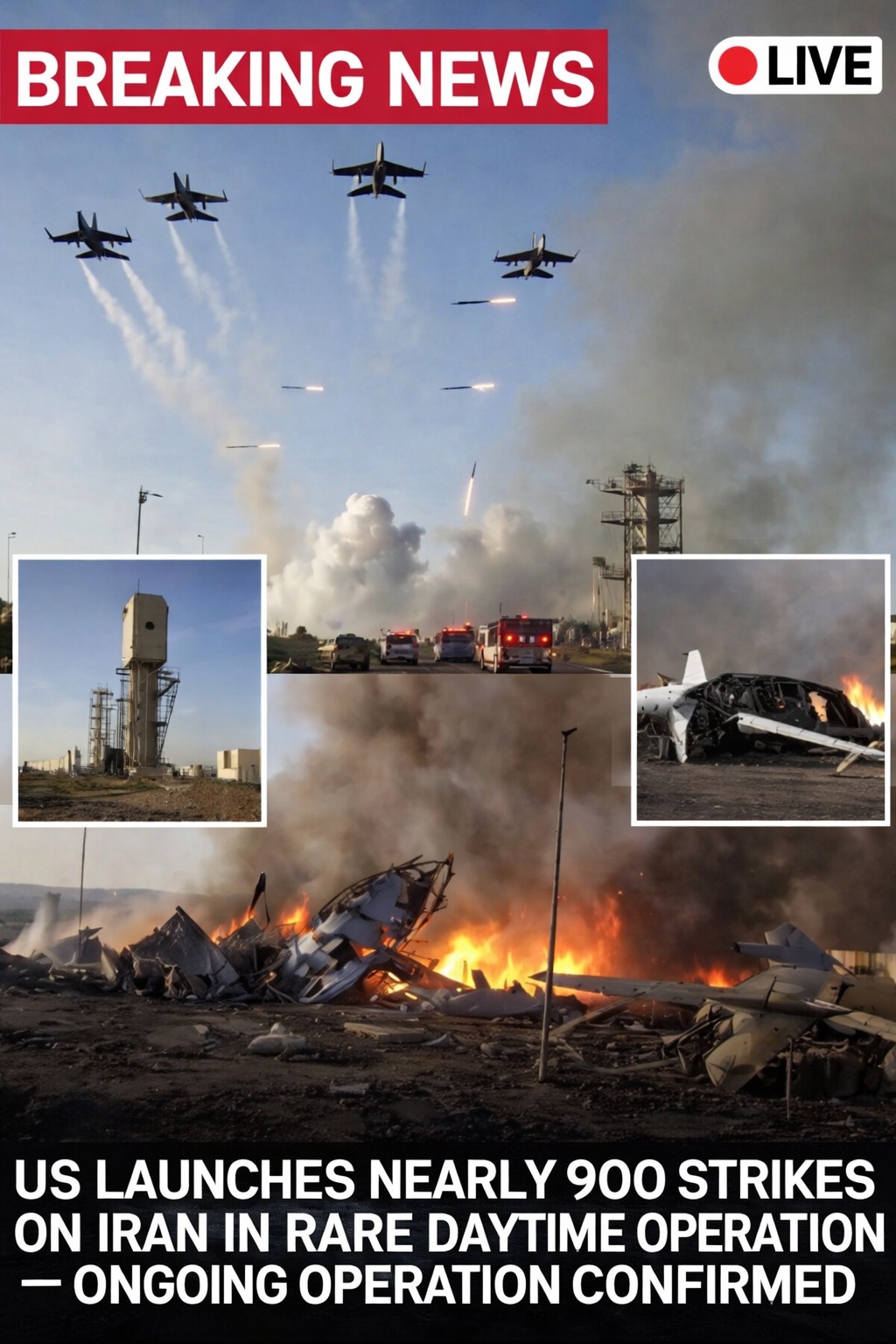
Witnesses across several regions reported seeing long white contrails streaking across the sky as missiles and aircraft moved toward their targets. Explosions were heard near several military facilities, while air defense systems reportedly activated in an attempt to intercept incoming projectiles.
If confirmed, this operation represents one of the largest coordinated strike campaigns in the region in decades, and it could significantly reshape the strategic balance in the Middle East.
A Rare Daytime Operation
Modern military doctrine often favors night operations for a number of reasons. Darkness provides natural concealment for aircraft and special operations forces, making it harder for defenders to detect incoming threats. Night raids also reduce the chance of visual detection by civilians and surveillance systems.
However, the reported U.S. strikes broke from this pattern.
Launching such a large operation during daylight sends a powerful signal. Analysts say daytime operations are sometimes used intentionally to demonstrate overwhelming confidence in air superiority and operational control.
In other words, conducting strikes under clear skies can communicate that the attacking force does not fear interception.
This psychological dimension may have been just as important as the physical targets themselves.
The Scale of the Operation
Initial reports suggest that the strikes targeted multiple categories of military infrastructure across different parts of Iran.
Among the facilities believed to have been hit were:
• Missile storage depots• Radar and early-warning installations• Air defense systems• Command and communication centers• Military bases linked to the Revolutionary Guard• Logistics hubs used for weapons transport
Military analysts believe the goal of the operation may have been to disrupt Iran’s ability to coordinate missile launches and defensive responses.
If key radar stations and communication networks are damaged, a military’s ability to track incoming aircraft and respond quickly can be significantly weakened.
This type of strategy is sometimes referred to as “blinding the battlefield.”
Why Target Radar and Missile Infrastructure?
In modern warfare, radar networks and missile systems form the backbone of a country’s defensive capability.
Radar systems detect incoming aircraft or missiles from long distances. Once a threat is identified, air defense units can launch interceptors to destroy the incoming weapon before it reaches its target.
By targeting radar hubs early in a conflict, an attacking force can reduce the effectiveness of defensive systems.
Missile depots are another critical target. Destroying stored missiles prevents them from being launched later in retaliation.
Military planners often aim to neutralize such assets early in an operation to reduce the risk of counter-attacks.
Visible Contrails Across the Sky
One of the most striking images emerging from the reported operation involved the sight of multiple contrails crossing the sky.
Contrails are long white trails left behind by aircraft or missiles traveling at high altitudes. They occur when hot exhaust gases mix with cold air in the upper atmosphere.
When dozens—or even hundreds—of missiles and aircraft move through the sky within a short period of time, the result can be a web of visible lines stretching across the horizon.
Residents in several areas reportedly shared images and videos showing these streaks cutting through the daytime sky.
Such visuals can have a powerful psychological impact, especially when they occur during daylight hours when they are clearly visible to large populations.
Air Defenses Activated
Iran’s air defense systems reportedly responded quickly once the strikes began.
Sirens and alert systems were activated in several locations, and defensive missile launches were reported in some regions.
Air defense units attempt to track incoming projectiles and launch interceptor missiles to destroy them before impact.
However, defending against large coordinated strike waves can be extremely challenging.
If attacks occur simultaneously from multiple directions or involve large numbers of missiles, defense systems may struggle to intercept every threat.
Military experts often describe this as a “saturation attack,” where the number of incoming weapons overwhelms defensive capacity.
Strategic Messaging
Beyond the immediate military impact, operations of this scale often carry strong political messages.
Large-scale strikes can serve multiple strategic purposes:
By conducting a visible operation during daylight hours, the attacking force may also be attempting to project confidence and dominance.
Such actions can reshape perceptions about who holds the upper hand in a conflict.
The Regional Context
The Middle East has experienced rising tensions in recent years due to a complex mix of geopolitical rivalries, military alliances, and regional conflicts.
Strategic competition between major powers has also increased the stakes.
Military bases, missile systems, and defense networks across the region are closely watched by intelligence agencies and defense planners.
Because many countries in the region host foreign military forces or participate in security partnerships, any large military operation can have wider implications for regional stability.
Global Reactions
Whenever an operation of this magnitude occurs, it tends to attract immediate global attention.
Governments around the world closely monitor developments that could disrupt international trade, energy markets, or regional security.
The Middle East remains one of the most important regions for global energy supply, and disruptions there can affect oil prices, shipping routes, and economic stability.
Diplomatic channels often become highly active during such moments as countries attempt to prevent further escalation.
The Risk of Escalation
One of the greatest concerns following large-scale military strikes is the possibility of retaliation.
When a country’s military infrastructure is targeted, leaders may feel pressure to respond in order to demonstrate strength and maintain domestic support.
Retaliatory actions can take several forms:
• Missile launches• Drone attacks• Cyber operations• Targeting foreign military bases• Attacks on shipping or strategic infrastructure
Each response increases the risk of further escalation.
This cycle of action and reaction is one of the reasons why military conflicts can expand rapidly once they begin.
Information and Media Impact
Another major factor in modern conflicts is the speed at which information spreads.
Social media platforms allow images, videos, and eyewitness reports to circulate globally within minutes.
This rapid flow of information can shape public perception and influence political decision-making.
However, it also presents challenges.
Not every video or photo shared online is verified. Some may be old footage, unrelated incidents, or even digitally altered material.
For this reason, analysts and journalists often emphasize the importance of verifying sources before drawing conclusions.
What Happens Next?
At this stage, many questions remain unanswered.
Military analysts will likely spend weeks examining satellite imagery, intelligence reports, and damage assessments to determine the full impact of the strikes.
Several possible scenarios could unfold:
• Diplomatic negotiations to reduce tensions• Limited retaliatory actions without full-scale war• Continued cycles of strikes and counter-strikes• Broader regional involvement if additional actors enter the conflict
History shows that moments like these can either lead to rapid escalation—or open the door for urgent diplomacy.
The Bigger Picture
Beyond the immediate headlines, this event highlights how warfare is evolving in the modern era.
Precision missiles, advanced aircraft, and coordinated strike campaigns allow militaries to conduct large operations within very short time frames.
Technology now enables operations that once would have required weeks of planning and massive troop movements.
At the same time, the political and humanitarian consequences of such actions remain profound.
Military operations can reshape alliances, influence global markets, and affect millions of lives.
Final Thoughts
The reported daytime strike campaign involving hundreds of coordinated attacks represents a dramatic moment in modern military history.
Whether it becomes a turning point in regional tensions or simply another chapter in a long cycle of conflict will depend on what happens next.
For now, governments, analysts, and citizens around the world are watching closely.
Because in today’s interconnected world, events in one region can quickly ripple across the entire globe.