
It is 9:50 p.m. on a Friday in late April 2025.
The autumn air settles over a farm in Neergabby, Western Australia — a wide, quiet stretch of red dirt and eucalyptus, about 80 kilometers north of Perth.
Inside the house, a 41-year-old woman is alone.
She has three children she has not been allowed to see.
She has a memoir finished and waiting to be published.
She has a lawsuit, a custody battle, and a body still recovering from a crash that put her in the hospital with what she described as kidney failure.
And somewhere in the back of her mind — perhaps — she carries a tweet she wrote six years ago: “I am not suicidal.”
Emergency services arrive. They attempt first aid.
The woman is pronounced dead at the scene.
Her name is Virginia Roberts Giuffre.
And the story of how she got to that farm, on that night, in that condition — is the story of what the world does to the girls it fails, then asks to save it.
She Was Running Before She Was Old Enough To Drive
Virginia Roberts was born in 1983 in Florida. She did not have the kind of childhood that produces comfort or trust.
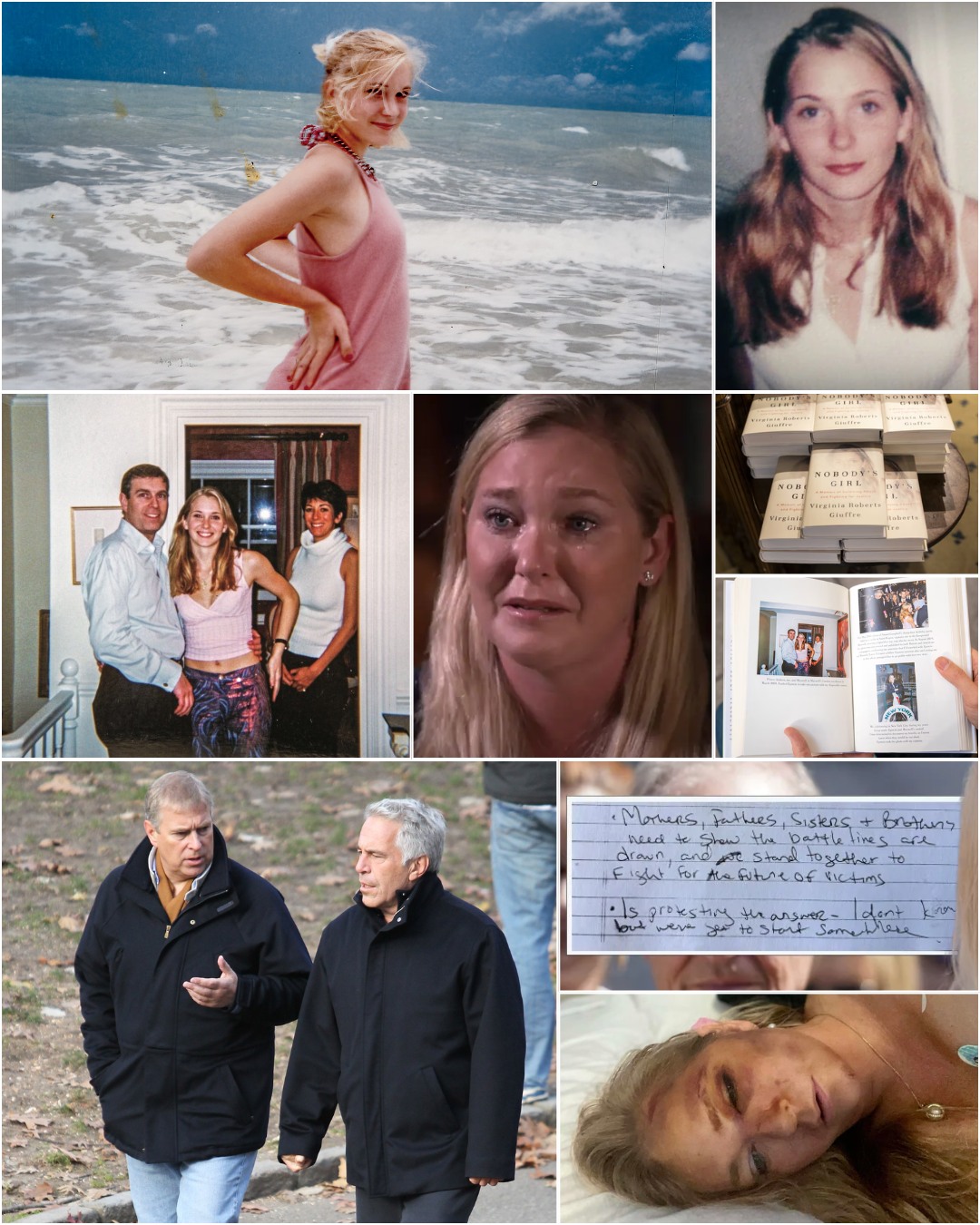
By her own account — account that would later fill 367 pages of a posthumous memoir — the people who were supposed to protect her were the first ones to hurt her. In Nobody’s Girl: A Memoir of Surviving Abuse and Fighting for Justice, published in October 2025, she wrote that the abuse began at home, with her father, before extending to a friend of the family she called “Forrest.” Her father, Sky Roberts, publicly denied these allegations in a note to the book’s ghostwriter.
What is not disputed is this: by the time Virginia was a teenager, she was already running.
She ran from violence. She ran from adults she couldn’t trust. She slept where she could find a place, worked whatever jobs were available, and looked for any door that might lead somewhere different from the life she was escaping. She ended up in a treatment center — what she described as a “tough-love” facility — until she managed to get out of there too.
There is a particular kind of grief that belongs to children like Virginia. Not the grief of losing something they had, but the grief of never having had it to begin with — the grief of growing up without a floor under your feet. You learn early that the world is not arranged to protect you. You learn to read rooms, to read people, to take whatever small chance appears because who knows when the next one comes.
That instinct — the one that says this person is offering something, so move toward it — would end up being both her survival skill and her greatest vulnerability.
In the year 2000, Virginia was working at Mar-a-Lago, the private Palm Beach club owned by Donald Trump. Her father had gotten her a job there, trying to give her a foothold in something normal. He worked on the tennis courts. She worked in the spa. It was, by any measure, a step forward — a real job, a real schedule, a chance at something resembling stability.
Then a woman walked in.
She was polished, British-accented, and effortlessly at ease in a room full of money. She introduced herself as Ghislaine Maxwell.
She told Virginia she was talented. She told her she had potential. She said she could arrange professional massage training, a real career path, a way to make good money doing something legitimate.
Virginia ran to tell her father. She was excited. She was seventeen years old and she thought, finally, someone saw her.
What no one told her — what she couldn’t have known — was that Ghislaine Maxwell was not a talent scout. She was a recruiter. And the man she was recruiting for was Jeffrey Epstein.
The World He Built, And What It Cost To Enter It

Jeffrey Epstein was, on paper, a financier. He had managed money for some of the wealthiest individuals in the world, built a network of relationships that stretched from Wall Street to the British Royal Family, and acquired properties that most people only see in movies: a townhouse in Manhattan, an estate in Palm Beach, a private island in the U.S. Virgin Islands, a ranch in New Mexico.
In reality, Epstein was something else entirely: the architect of a systematic, years-long operation to recruit, groom, and sexually exploit young women — most of them from vulnerable backgrounds, most of them teenagers.
The machinery of that operation worked through Ghislaine Maxwell, who would identify candidates, approach them with warmth and opportunity, then deliver them to Epstein under the cover story of “massage training.” Once inside that world, the exits were harder to find than the entrances.
Virginia later described what happened after she arrived at Epstein’s Palm Beach home for the first time. She was brought upstairs. She was told to give Epstein a massage. Maxwell stripped her of her clothing. And then she was sexually assaulted.
“I thought, sex is all they will ever want from me,” she wrote in her memoir.
She was right about that — and wrong about how far it would go.
In the years that followed, Epstein and Maxwell loaned her out. That is the only word for it. She was flown on private jets to properties around the world. She was introduced to wealthy, connected, powerful men who understood, without anything needing to be said aloud, what she was there for. “They lent me to numerous wealthy, powerful people,” she wrote. “I was routinely exploited and humiliated, and, in some cases, choked, beaten, and bloodied.”
She was, as she would later tell the world, a sex slave. Not a metaphor. A fact.
Among the men she was trafficked to was a member of the British Royal Family: Prince Andrew, the Duke of York, second son of Queen Elizabeth II. She alleged he abused her on three separate occasions — once at Ghislaine Maxwell’s London townhouse, once at Epstein’s New York home, and once on Epstein’s private island during what she described as an “orgy” involving approximately eight young girls, none of whom appeared to speak much English.
On the first occasion, in London, someone took a photograph.
Virginia, seventeen, round-faced and young in a way the camera caught honestly. Prince Andrew beside her, his right arm wrapped around her waist. Ghislaine Maxwell in the background, smiling the comfortable smile of a woman who knows she controls the room.
That photograph would become one of the most debated images in the modern tabloid era. For years, supporters of the prince insisted it was manipulated, a fake, an invention. Virginia’s father would later say he had seen an 8×10 print of that same photograph years before it was ever published — Virginia had sent it to him herself. “She sent the original,” he said. “So I know it wasn’t fabricated.”
It was not fabricated. The emails that began surfacing in early 2026 would confirm as much — correspondence apparently written by Maxwell that seemed to discuss the photograph’s existence. Virginia’s family called it vindication.
But that vindication came years too late.
Jane Doe 102 Steps Into The Light
For a long time, Virginia was a name on a legal filing, not a face in a newspaper.
She came forward initially under the anonymized designation “Jane Doe 102,” filing a civil complaint against Epstein and Maxwell that accused them of recruiting and abusing her while she was a minor.
Epstein, using the money and legal firepower available to a man of his connections, maneuvered the American justice system into one of the most criticized plea deals of the modern era. In 2008, he reached a non-prosecution agreement with federal prosecutors in Florida — a sweetheart deal that allowed him to plead guilty to two state charges of soliciting prostitution, serve just 13 months in a county jail (during which he was permitted to leave the facility six days a week for “work release”), and avoid federal charges despite documented evidence involving dozens of minors.
The deal was kept secret from the victims. Federal law required prosecutors to notify victims of such agreements. They were not notified. The deal was, in the words of a federal judge who later reviewed it, illegal.
For Virginia, watching the legal system absorb Epstein’s wealth and connections and spit out a minor charge — watching the man who had stolen years of her life walk into a country club disguised as a jail — was a reckoning. The system was not going to help her. It had already chosen sides.
But Virginia made a choice too.
She stepped out of the shadow of “Jane Doe 102.” She took back her name. And she started talking.
She gave interviews to investigative journalists. She spoke to the Miami Herald’s Julie K. Brown, whose landmark 2018 investigation Perversion of Justice would become the catalyst for Epstein’s eventual federal arrest in 2019. She connected with victim advocates. She went on camera, in print, on record.
Every time she opened her mouth, she knew she was poking at people who had the resources to destroy her. Every time she said his name out loud, she was measuring the distance between what was true and what she could prove.
But she kept going. That is the thing about Virginia that no headline ever fully captured: the relentlessness of it. The decision, day after day, to keep being the most visible person in a story that made powerful men uncomfortable. To keep refusing to be quiet.
The Photograph, The Lawsuit, And The Prince Who Paid
By 2021, the landscape had shifted.
Jeffrey Epstein was dead — found in his cell at the Metropolitan Correctional Center in New York in August 2019, in a death officially ruled suicide by hanging, though the circumstances, including malfunctioning cameras and sleeping guards, have never been fully explained to the public’s satisfaction.
Ghislaine Maxwell was in custody, awaiting what would become a federal trial on sex trafficking charges. In December 2021, she was convicted on five of six counts. She received a 20-year sentence.
And Virginia, watching the pieces of the machinery she had named for years finally come apart in public, took the step she had been building toward for a long time.
In August 2021, she filed a civil lawsuit against Prince Andrew in the United States District Court for the Southern District of New York, alleging that he had sexually assaulted her when she was 17 — a minor under both American and British law.
Prince Andrew denied everything. He had been denying it for years, most memorably in a November 2019 BBC Newsnight interview that became instantly, catastrophically infamous. He said he had “no recollection” of meeting Virginia Giuffre. He offered an explanation for why he couldn’t have been at the specific London nightclub the evening the photograph was taken — he’d been at a Pizza Express in Woking, he said, for a birthday party. He said he had a medical condition that prevented him from sweating, which was relevant because Virginia had described him sweating during a dance at Tramp nightclub that evening.
The interview was widely described as a disaster. Former royal press secretaries called it the worst royal interview in modern history. Public relations professionals studied it as a case study in how not to handle a crisis.
And still, Prince Andrew maintained the denial.
Then came February 2022. His legal team filed a motion to dismiss the lawsuit. The judge denied it. The case was going to trial. And in the weeks before that could happen, Andrew reached an out-of-court settlement with Virginia.
The exact financial figure was never disclosed, but reporting suggested the settlement amount ran into the tens of millions of dollars — likely drawn from money borrowed against Andrew’s royal properties and reportedly contributed by Queen Elizabeth herself before her death in September 2022. Virginia’s estate at the time of her death was thought to be valued in the millions, including what remained of the Andrew settlement.
The settlement included a statement in which Andrew said he “recognized” Virginia had “suffered both as an established victim of abuse and as a result of unfair public attacks” — but contained no admission of liability and no apology for what she had specifically alleged.
For Virginia, it was imperfect justice. A man who had repeatedly denied ever meeting her was paying her a substantial sum to avoid going to trial. He did not say he was wrong. He did not say she was right. He put money on the table and moved away from the courtroom.
But the money told its own story. And Virginia knew it.
The Farm At The End Of The World
There is a version of this story where Virginia Giuffre gets her ending.
She moves to Western Australia. She marries Robert Giuffre, who she had known for years. They have three children — Christian, Noah, and Emily — and build a life on a property in the hills outside Perth, far from the Manhattan courtrooms and the tabloid cameras and the world that kept needing her to perform her trauma for their consumption.
She does advocacy work. She speaks at conferences about human trafficking and survivor rights. She connects with other women who are where she once was. She has, for perhaps the first time in her adult life, something resembling agency over her own story.
She is, as her family would say, “the light that lifted so many survivors.”
That version is true. It is also incomplete.
Because the private version of those years — the version that only emerged in fragments, in court filings and Instagram posts and whispered conversations with journalists in her final weeks — was a different story entirely.
Virginia and Robert Giuffre separated in 2023 after 22 years of marriage. According to her family, Virginia had described her husband as abusive during the marriage. He was never charged with any offense, and his lawyers declined to comment on the allegations. But the separation triggered something worse: a family violence restraining order that, in the months leading up to her death, had the practical effect of separating Virginia from her three children.
Think about what that meant for her.
A woman who had spent her entire adult life fighting for other people’s children, who told every interviewer that holding her own newborn daughter had been the moment she decided to keep fighting — that same woman was barred by court order from freely seeing her kids.
In February 2025, Robert accused Virginia of breaching that restraining order. A court hearing was set. Virginia, from her hospital bed in early April, told reporters she denied violating the order and would defend herself against what she called “his malicious claim.”
She never got the chance.
And then, on March 24, 2025, a school bus hit the car she was traveling in near Neergabby.
“They Gave Me Four Days To Live”
The collision happened on a rural road in Western Australia. According to Virginia’s own account on social media, posted from a hospital bed with photographs showing her face badly bruised and her body visibly injured, a school bus traveling at approximately 110 kilometers per hour struck her vehicle while she was slowing to make a turn.
“Your car could be made of whatever it wants,” she wrote. “It’s still a tin can.”
She said she had gone into kidney failure. She said her doctors had given her four days to live. She said she was being transferred to a specialist unit for urology. And she said — the words that would reverberate for months afterward — that she was “ready to go,” but wanted to see her children one last time first, something she said she might not be allowed to do.
The post was raw in a way that made people uncomfortable. It read like a goodbye.
Her representative confirmed to media outlets that she had been in a serious accident and was undergoing treatment in hospital. The injuries were real. The hospitalization was real.
Here is where the story gets complicated in a specific, important way: Western Australia police, when asked about the accident, described it as a “minor collision” in which no injuries were reported.
A minor collision. No injuries.
That description sits next to Virginia’s photograph of her bruised face, her report of kidney failure, and the confirmation from her own representative that she was hospitalized — and something in the arithmetic does not add up.
It is possible that the police were describing the official crash report, which may not have captured what happened to her body in the days following. It is possible that Virginia, in pain and frightened and already in a fragile state, amplified what she was experiencing through the distorting lens of trauma. It is possible that both things are partially true.
What is not possible is to look at the post she wrote from that hospital bed — the one that said she was ready to die, that she just wanted to see her kids — and not understand it as a person in crisis.
She posted it. She put her bruised face into the world. And then she went home.
Four weeks later, she was dead.
“I Am Not Suicidal”
There is a tweet from 2019 that has been circulating since April 25, 2025, every time someone types Virginia Giuffre’s name into a search engine.
In that tweet, Virginia wrote that she was not suicidal. That she had made this clear to her therapist and her doctor. That if anything happened to her, she wanted people to “not let it go” — because there were too many powerful people who wanted her silent.
In 2019, the tweet read like a precaution. Like someone doing the responsible thing, creating a paper trail, making her feelings known before something could be arranged to look like something it wasn’t.
Jeffrey Epstein died in his cell on August 10, 2019 — roughly three months after Virginia posted that tweet.
The official ruling was suicide by hanging. The cameras outside his cell malfunctioned during the relevant time window. The two guards on duty were asleep and later admitted to falsifying records to show they had been making their rounds. Epstein had allegedly been taken off suicide watch days after a prior incident in his cell.
The combination of those details — the malfunctioning cameras, the sleeping guards, the prior incident — has never produced a convincing unified explanation. It has produced, instead, a permanent public suspicion: that a man who knew the secrets of some of the most powerful people in the world did not die by his own hand.
Whether or not that suspicion is correct, it changed the atmosphere around everyone connected to the Epstein case. It changed the way people read Virginia’s 2019 tweet when her death was announced six years later.
Her father, Sky Roberts, did not hesitate.
He went on television — sitting across from Piers Morgan, eyes red, voice cracking — and he said what he believed: “She would never do this to herself. Somebody got to her.”
He talked about her plans. She had been working toward something on that farm — a refuge, a sanctuary, a place where trafficking survivors could come and be safe. A project she was building with her own hands, on her own land. He talked about how much she loved her children. He talked about how strong she was.
He said, more than once: she would never leave her kids. Never. Not voluntarily.
And then he said: somebody got to her.
What The Lawyer Said, And What She Meant
Virginia’s Australian attorney, Karrie Louden, was caught in the middle of something she hadn’t anticipated.
Days after Virginia’s death, she was quoted — in the context of the chaos that followed any public statement about the case — as expressing doubt about the suicide ruling and drawing a distinction between “suicide” and “misadventure.” Misadventure, in Australian legal terms, refers to an accidental death resulting from an unnatural cause, including situations where the deceased was willingly taking a risk.
The internet treated that distinction as confirmation of something sinister.
Louden came back through PEOPLE magazine with a correction. She said her comments had been misinterpreted. She said she did not believe Virginia’s death was suspicious in any criminal sense. She said she was not alleging foul play.
What she said, verbatim, was: “I am not willing to speculate on her cause of death as to whether it was suicide or misadventure. I do not believe it was suspicious in any way. The Coroner will determine in due course the cause of death and that will be established based on the evidence.”
She described Virginia as a “fighter” who had inspired many people. She said Virginia had been in emotional and physical pain but had also been “looking forward to the future.”
That tension — between a person who is in desperate pain and a person who still believes the future holds something — is not a contradiction. It is precisely how crisis works. People can want to live and want it all to stop at the same time. Those two impulses can exist in the same body on the same day.
But the statement did not resolve anything. It clarified Louden’s position. It did not explain what happened on that farm.
By late 2025, Western Australia police had confirmed that the case remained under investigation by Major Crime detectives, that early indications continued to show the death was “not suspicious,” and that a full report would be prepared for the coroner.
No coroner’s report was publicly released. No forensic report. No toxicology results made available to the media.
The information ended there.
And in the absence of information, people filled the silence with everything they had already been thinking.
The Memoir That Arrived After She Was Gone
In October 2025, Nobody’s Girl: A Memoir of Surviving Abuse and Fighting for Justice was published by Penguin.
Virginia had been working on it for years. She did not live to hold it.
The book was 367 pages. It was the full story — not the version edited for a deposition, not the version shaped by legal strategy, not the version delivered in a press conference. The whole thing, from the beginning. The father, the family friend, the treatment center, Maxwell at Mar-a-Lago, Epstein’s Palm Beach house, the flight logs and the island and the men she was taken to.
The New York Times called it “both sad and devastating.” The Guardian called it “a devastating exposé of power, corruption and abuse.”
She wrote about Andrew on three separate occasions. She wrote about what she called an “orgy” on the island. She wrote about fear — the specific fear of a young woman who understood that the men who were using her were the kind of men who could make problems disappear.
She wrote: “From the outset, they manipulated me into engaging in behaviors that eroded my ability to understand reality and prevented me from defending myself.”
She wrote: “I thought I might die a sex slave.”
The BBC, which obtained an early copy, reported that the memoir contained detailed allegations against a “well-known Prime Minister” — a new name that had not appeared in Virginia’s previous legal filings, a revelation that sent media organizations scrambling to identify who she was describing.
The book sold immediately. Reviews poured in. Journalists who had covered Epstein for years called it the most complete firsthand account of how his operation worked, from the inside, from the person who had been most willing to describe it.
Virginia had written it so that, when she was gone, the record would be complete.
She knew, on some level, that she might not be there to defend it. The book reads that way — like a statement written for posterity, not for a promotional tour.
The Files Start Opening
While the memoir was being read, something else was happening: the Epstein files were finally coming out.
For years, victims and their advocates had been fighting in American courts to force the release of documents related to Epstein’s operation. Various court proceedings — including the civil case involving Ghislaine Maxwell, and separate civil suits filed by other victims — had produced partial releases. But the full scope of what the FBI and the Justice Department held had never been made public.
In 2024, Congress passed legislation requiring the DOJ to release the files on a specific timeline.
The releases began in December 2025 — heavily redacted, criticized by both Democrats and Republicans as inadequate, with over 500 pages in some batches entirely blacked out.
On January 30, 2026, a massive trove of approximately three million pages was released.
Those documents included Epstein’s communications with former political operatives, billionaires, business executives, and Andrew Mountbatten-Windsor — the man formerly known as Prince Andrew.
In one set of emails, Epstein appeared to be introducing a young woman to Andrew, describing her as “26, very beautiful, trustworthy.” The emails were interpreted by investigators as consistent with the pattern Virginia had described: Epstein procuring women for powerful men.
In another batch of emails, Ghislaine Maxwell appeared to reference the notorious photograph — the one with Andrew’s arm around Virginia’s waist, the one Virginia’s father had said he’d seen years before it leaked.
Virginia’s family said the emails “vindicated” her.
The man in the photograph was not debating whether it was real anymore. He had other problems.
The Man In The Photograph Gets Arrested
On February 18, 2026, Andrew Mountbatten-Windsor — stripped of his title of “Prince” and his Dukedom of York in October 2025, in an unprecedented action by King Charles — was arrested at his home near Sandringham in Norfolk.
Thames Valley Police confirmed the arrest on suspicion of misconduct in public office.
The charges stemmed from emails revealed in the January 30, 2026 document release. Those emails appeared to show that Andrew, while serving as the United Kingdom’s Special Trade Envoy between 2001 and 2011, had forwarded confidential governmental reports — including sensitive commercial and diplomatic information from official visits to Hong Kong, Vietnam, and Singapore — to Jeffrey Epstein.
He was released the same day under investigation. He was not charged. The Metropolitan Police had separately confirmed they were “actively looking into” reports that Andrew had used his Metropolitan Police bodyguard to try to dig up damaging information about Virginia Giuffre in 2011 — passing her date of birth and Social Security number to an officer assigned to protect him.
Virginia’s family put out a statement on the day of his arrest.
“No one is above the law,” they wrote.
And then: “On behalf of our sister, we extend our gratitude to the UK’s Thames Valley Police for their investigation and arrest of Andrew Mountbatten-Windsor.”
Our sister.
Not the accuser. Not the victim. Their sister.
The woman they had buried ten months earlier, on that farm in Neergabby, was still fighting through them. Still making news. Still pulling at threads that others had spent years trying to bury.
She didn’t live to see this day.
She had predicted it.
What Is Left: The Estate, The Children, The Court
In the months after Virginia’s death, the legal machinery did not stop — it redirected.
Because Virginia died without a valid will, her estate became the subject of contested proceedings in the Supreme Court of Western Australia.
Her estate was significant. Reports suggested it was valued in the millions of dollars — including what remained of her settlement with Andrew after legal fees, plus her properties in Western Australia, including the Ocean Reef home she had purchased in 2020 for $1.9 million.
Her sons Christian and Noah — 19 and 18 at the time — filed to be named administrators of the estate. They were opposed by Virginia’s former barrister Karrie Louden and her former housekeeper Cheryl Myers, both of whom apparently had claims against the estate. Her estranged husband Robert Giuffre potentially had a legal entitlement to as much as one-third of the estate under intestacy rules — a prospect Virginia had apparently anticipated and explicitly opposed.
According to reporting by The Nightly, Virginia had emailed her lawyers shortly before her death, instructing them that she did not want Robert to receive “one cent.”
Her brothers and her paternal aunt were also involved in competing claims, each with different positions on where the money should go. The aunt said it should go entirely to the children. The brothers were also asserting claims. The case management hearings continued into late 2025 and were expected to continue into 2026.
Her daughter Emily — the youngest, whose birth Virginia had described as the moment that changed everything — was old enough to potentially be added as a claimant as well.
The family that Virginia had wanted, the children she had built that farm for, were now in a courtroom fighting over the pieces of what she left behind.
The irony was the kind that doesn’t have a punchline.
The Third Person In The Epstein Circle To Die
The arithmetic of the Epstein case has a particular weight to it.
Jeffrey Epstein: dead in his cell, 2019. Official ruling: suicide. Circumstances: unresolved.
Virginia Roberts Giuffre: dead on her farm, 2025. Family’s statement: suicide. Father’s position: murder. No coroner’s report publicly released as of early 2026.
Add to that the deaths of other individuals connected tangentially to the case over the years, and the pattern — real or perceived — starts to feel like something more than coincidence to people who have been following it.
This is where we have to be honest about something.
There are two things that can be true simultaneously.
The first is that Jeffrey Epstein’s circle included people with the motive, the means, and the demonstrated willingness to protect themselves through extraordinary measures — and that in that context, skepticism about official rulings in deaths connected to the case is not irrational. The world has seen too much of how power operates to dismiss it entirely.
The second is that Virginia Giuffre was a 41-year-old woman who had survived a lifetime of compounded trauma, who was in physical pain following a serious car accident, who had been separated from her children by court order, who was in the middle of a contentious divorce from a man she accused of abuse, whose financial affairs were tangled up in litigation, and who had posted publicly from a hospital bed that she was ready to die. The profile of someone in extreme psychological crisis is not a theory — it is a documented, observable reality.
The uncomfortable truth is that both of those things can be true, and we cannot fully know which one applies here, because the information that would settle it — a complete coroner’s report, a full forensic record, a toxicology analysis — has not been made public.
What we know is what Virginia’s family said. What we know is what the police said. What we know is what the people around her observed.
What we don’t know is everything else.
“Somebody Got To Her”
Sky Roberts is a man who lost his daughter.
Whatever the complexities of their relationship — and the memoir raised complexities that he has publicly denied — on the day Virginia died, he was a father who got news that no parent should get.
He went on television and said what he believed. He said she would not have done this to herself. He said she had things to live for. He said the farm was going to be a sanctuary for other survivors. He said she was strong.
He said somebody got to her.
It is worth pausing here to ask: what would it mean if he were right?
It would mean that a woman who survived Jeffrey Epstein, survived Ghislaine Maxwell, survived a legal system that originally sided with her abuser, survived a prince’s army of lawyers, survived a thousand attempts to discredit and silence and minimize her — made it through all of that, only to be killed on a quiet farm in Western Australia before the biggest batch of Epstein documents in history was released.
It would mean the timing was, at minimum, notable.
But it would also require someone to have reached her in rural Western Australia, on a private farm, in the middle of the night, leaving no trace that any investigator examining the scene found significant enough to elevate the case from “not suspicious” to “homicide.”
None of that is impossible. Nor is it established. The absence of a full public record means neither conclusion can be ruled in or out.
What Sky Roberts’s grief contributes to the record is this: a father who knew his daughter, who watched her fight for twenty years, who sat with her in her final weeks, could not accept that she stopped on her own.
That belief deserves to be heard.
So does the evidence that she was suffering, deeply and continuously, in ways that had been accumulating for decades.
What The Files Revealed After She Was Gone
Between September 2025 and February 2026, the full dimensions of what Virginia had been describing since 2000 came into view.
Thousands of pages of FBI records. Photographs from Epstein’s properties. Flight logs from his private jets. Internal communications between Epstein, Maxwell, and the men in their orbit. Video from his island in the U.S. Virgin Islands. Email chains that placed people at specific properties on specific dates.
On December 4, 2025, Democrats on the House Oversight Committee released 73 photographs and four videos from Epstein’s estate on Little St. James — the private island where Virginia said she was taken, where she described witnessing things she knew she would carry forever.
On January 30, 2026, three million pages of documents hit the public record.
The documents confirmed what Virginia had been saying for more than two decades: that Epstein’s network was real, that it extended into the highest levels of political and financial power in multiple countries, that the system had actively protected him for years while his victims were dismissed, disbelieved, and in some cases targeted.
The documents also raised a new problem: names of victims — women who had never chosen to identify themselves publicly, women whose entire protection rested on anonymity — appeared unredacted in portions of the release. Attorneys for survivors called the DOJ immediately. They said it was “an impossible job” to identify and remove them all.
So even in the disclosure, the victims paid a cost.
Virginia, who had spent years arguing that the system consistently prioritized the comfort of powerful men over the safety of the women they harmed, would not have been surprised.
She would, in all likelihood, have been furious.
The World She Helped Build By Refusing To Disappear
It is worth accounting for what Virginia Giuffre actually changed.
She was not the only person who accused Jeffrey Epstein. There were many. What she was, uniquely, was the most visible — the one who put her name and face on the record earliest, who took the most aggressive legal action, who named the most powerful names out loud, repeatedly, across multiple countries and multiple legal jurisdictions.
Without Virginia Roberts Giuffre, the 2008 plea deal might have never attracted the scrutiny that led Julie K. Brown to begin her investigation. Without Brown’s investigation, there might not have been a 2019 federal arrest. Without the 2019 arrest, there might not have been the pressure that eventually led to Maxwell’s prosecution. Without Maxwell’s prosecution, the full network of what Epstein built might never have been pulled into the light even partially.
None of that chain of events is hers alone. But she is the thread that runs through all of it.
She also forced a member of the British Royal Family to respond in court — something that had never happened before and may never happen again in quite this way. When Andrew wrote a check and walked away from a civil trial, that act itself was a kind of testimony. It told the world something. It told the world that a boy from a farm in Florida with no money, no connections, and nothing but the truth could make a prince pay for what he did.
Formerly Prince Andrew is now a man named Andrew Mountbatten-Windsor who has been arrested by British police, stripped of his titles, and released under investigation while detectives examine whether he used his official position to serve the interests of a convicted child sex offender.
Virginia Giuffre did not live to see that.
But her family was alive to say: “On behalf of our sister, we extend our gratitude.”
The Price Of Being The One Who Speaks
There is something the media cycle does not account for when it covers survivors.
It covers the moment of accusation. It covers the trial. It covers the verdict. And then it moves on.
The survivor does not move on. She carries the trial inside her body. She carries the years of being doubted in every conversation she has with a stranger. She carries the depositions and the cross-examinations and the moments when a lawyer in an expensive suit implied, in front of a courtroom, that she was lying.
She carries the social media comments. The message boards. The people who, to this day, insist that the photograph was fabricated, that she was a gold digger, that she invented the whole thing.
She carries her children growing up knowing that their mother’s name is searchable, that her history is public, that a stranger on the internet can read about the worst things that were ever done to her.
Virginia Giuffre carried all of that for more than twenty years.
And she did it publicly. She made a choice, over and over, to remain visible — because she understood that visibility was the only protection she had, that the moment she disappeared was the moment she became easier to dismiss, discredit, and ultimately bury.
That decision cost her.
It cost her the kind of ordinary privacy that most people never think about. It cost her the ability to heal without witnesses. It cost her, perhaps, more than we will ever fully know.
The memoir that was published after her death does not read like the testimony of a woman who was done. It reads like the testimony of a woman who was still in the middle of something, who was writing it all down because she needed the record to be complete, who knew on some level that there might not be enough time to say everything she needed to say.
She said it anyway.
What The Coroner Has Not Yet Said
As of February 2026, the following remains true:
Western Australia Police have confirmed that Virginia Giuffre’s death is under investigation by Major Crime detectives. They have confirmed that early indications suggest the death is not suspicious. They have confirmed that a report will be prepared for the coroner.
The coroner has not released a public report.
No toxicology results have been made available to the media. No full forensic report has been published. No timeline has been given for when the coroner’s investigation will conclude.
Virginia’s family filed their statement in the hours after her death, describing it as suicide following a lifetime of sexual abuse and trafficking. Her father has said publicly and repeatedly that he does not believe that account. Her attorney clarified that she does not believe there was criminal involvement.
The estate is in litigation. The children are in court. The files are still being released. The man she once sued is under arrest.
And the woman who set all of that in motion is gone.
The world did not protect Virginia Giuffre when she was a teenager who needed protection. It did not listen when she first spoke. It put more resources into Epstein’s defense than into his victims’ wellbeing. It let the people around her walk free for years while she carried the weight of naming them.
When it finally started to listen — really listen, in the way that comes with Senate hearings and congressional legislation and millions of released documents — she was no longer here to hear it.
Three Times She Tried To Start Over
There is a version of Virginia’s life that can be counted in attempts at beginning again.
The first attempt: the job at Mar-a-Lago. Seventeen years old. Her father on the tennis courts. A chance at something stable. That attempt was taken from her by a woman named Ghislaine who smiled like she was doing a favor.
The second attempt: leaving the Epstein world, getting married, moving to Australia, having children. Building a life on the other side of the Pacific, where the names didn’t follow her so loudly. That attempt worked, for a while. And then the past kept arriving — in the form of interviews she felt she had to give, lawsuits she needed to file, depositions she had to sit through, and the relentless awareness that if she went quiet, the powerful men she’d named would use the silence against her.
The third attempt: the farm in Neergabby. The plan for a refuge. A place for survivors that would be built with her own hands on her own land. A future that was not defined by what had been done to her, but by what she was building for others.
She did not complete that third attempt.
What we are left with instead is a memoir. A coroner’s case that remains open. Three children in a courtroom. A father on television. A formerly royal man under arrest. Three million pages of documents. And a name that will not stay buried, no matter how many times the powerful people it threatens might wish it would.
She Never Stopped Being Right
Here is the thing that the documents released in late 2025 and early 2026 confirm, in case there was any remaining doubt:
Virginia Giuffre was telling the truth.
The network she described was real. The flights were real. The island was real. The men she named have now been placed, by documentary evidence, in the same orbit she said they were in. The photograph that was called a fake is confirmed by emails from Maxwell as something she was aware of, something that existed, something that the people around Andrew spent years trying to manage.
She was right.
She was right when she was seventeen and sitting in front of a lawyer who was paid to make her look unreliable. She was right when she filed her first anonymous lawsuit as Jane Doe 102. She was right when she gave her first on-camera interview, knowing people would question her motives. She was right when she sued Prince Andrew. She was right in every deposition she sat through, every courtroom appearance she made, every time she looked into a camera and said, simply: this happened to me.
It happened.
The world knows now, with as much certainty as three million pages of federal documents can provide, that it happened.
And the woman who spent twenty years telling us so did not live to see the full acknowledgment.
She died nine months before the largest document release. She died before Andrew Mountbatten-Windsor was arrested. She died before her family was able to say, on the record, with police confirmation: “No one is above the law.”
She died before the world fully came around.
What We Owe Her Now
There is a question that Virginia’s story forces, and it does not resolve neatly.
When we ask survivors to come forward, we are asking them to do something that will cost them enormously. We are asking them to relive their worst experiences in public, under cross-examination, for years. We are asking them to accept that they will be disbelieved, investigated, mocked, and in some cases threatened. We are asking them to stay visible — because visibility is protection, yes, but it is also exposure.
We make those demands and then we leave them to carry the consequences alone.
Virginia Giuffre carried those consequences for over two decades. She carried them through the 2008 plea deal that let Epstein go free. She carried them through the years when his name barely registered in mainstream news. She carried them through the Newsnight interview, through the legal battles, through the custody dispute, through the car accident, through the kidney failure.
She carried them to that farm.
Whatever happened on that farm — whatever the coroner eventually says, whenever they say it — the conditions that led to that night were built over years, by a world that asked one woman to absorb an unfair amount of pain in the service of everyone else’s eventual understanding.
That is not a tribute to Virginia’s strength, though she was enormously strong.
That is an indictment of the way we handle survivors.
We hold them up as symbols. We call them warriors. We say they gave us justice. And then we do not give them the resources, the sustained support, or the basic human protection they need to actually survive the fight.
Virginia Giuffre fought for every person who will ever read her name. She fought for the women who couldn’t. She fought for the children who came after her. She fought for the truth, for two decades, against the most powerful machinery of denial that money could construct.
The world believed her, eventually. Not quickly enough. Not while she was still here to know it fully.