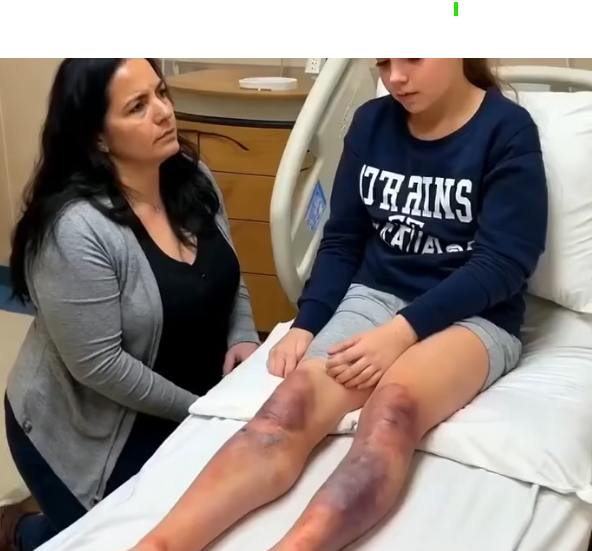
The phone call came in the middle of an ordinary Tuesday, the kind of day stitched together from paperwork and burnt office coffee, and I thought my fifteen-year-old daughter Sophie just wanted to show me something funny from her trip with my family. Instead, the screen filled with her face—pale, strained, fighting tears—and then with an image I will never forget: her leg, swollen and bruised in shades skin should never be. She whispered that she’d fallen the day before, that she told everyone it hurt, that my parents and brother made her walk three hours anyway, calling her dramatic, sensitive, too much like me. They had gone out again that morning, leaving her alone in a hotel room in another state with a leg she literally could not stand on. Something inside me snapped—not loudly, but cleanly—as I told her to stay put while I booked a flight I’d been terrified of for a decade.
The moment the plane touched down, I was running. When Sophie opened the door, she looked both relieved and bewildered, as if she had only half believed I would come. Seeing her injury in person was worse—angry purple swelling across the bone, a quiet proof of her suffering—and fifteen minutes later, we were in an ER where she told the fuller truth: she hadn’t simply fallen; her cousin Ben had shoved her as a joke. My family watched it happen. My mother laughed. My brother told her to stop scaring the tourists. The X-ray confirmed what instinct had already screamed—fracture. A clean break. A preventable one. As Sophie sat quietly beside me, apologizing for being “a problem,” I realized just how thoroughly they had taught her to doubt her own pain the same way they taught me.
That night, I confronted them. My father dismissed it. My mother deflected. My brother scolded me for “making drama,” the same phrase they had used to justify leaving my daughter behind. But when security footage surfaced—showing the shove, the fall, the laughter—everything changed. I sent the video and the medical report straight to my lawyer. The hearings were quiet, clinical, devastating. Child endangerment. Medical neglect. Professional consequences for my brother. Financial ones for the others. They called me cruel. They called me vengeful. They said I was ruining the family. But the truth was simple: I wasn’t destroying anything—I was finally refusing to let them destroy my daughter the way they once destroyed me.
Sophie healed with a steadiness that amazed me, not just physically but emotionally. One evening, she folded laundry beside me and admitted she might have forgiven them if I had asked her to. “But I’m glad you didn’t,” she added softly. “I needed someone to believe me.” And that was it—that was the moment I understood what this entire storm had been about. Not revenge. Not punishment. Protection. Breaking a cycle that had been handed to me like an inheritance. Now, when we travel together—sometimes even on airplanes—I still feel the old fear tighten in my chest. But then I remember her voice from that hotel bed, trembling but hopeful: You actually came. And I know I will always come. Always.