
The last night bus of the route screeched to a halt in front of a lonely sign that read: Redwood Plains. The hour sat somewhere between twilight and full darkness, and the Nevada sky was already cooling into deep violet. A cold wind brushed across the empty parking lot, sending curls of dust clinging to the boots of Miles Harwood as he stepped down onto cracked pavement.
He carried only one thing worth mentioning, a faded canvas backpack strapped across his chest. Inside, brick-like stacks of cash were packed into plastic sleeves. Eighty thousand dollars in worn bills. Every one earned through a year in places where daylight barely existed and names were never given aloud. A year in the mines beyond the border. A year where mountains were blown open for minerals, and men went missing without anyone pausing to count.
That morning, on the edge of the desert, he had told himself: This money will fix everything. It was the same sentence that had fueled him through twelve months of sleepless work. He never called home. He did not write. Not even once did he send money back. He wanted to appear one day at the front door and say, I did it. He imagined her face. He imagined holding his child again.
His wife, Tessa Clairmont, had given birth just three months before he left. Their son, Cal, had not even opened his eyes properly when Miles boarded a pickup truck that drove him away. Tessa had begged him to wait a few months more, but poverty felt like a wolf chewing their bones. He had believed that sacrifice would make him a hero.
As he walked from the bus stop, the town seemed smaller than he remembered. Storefronts leaned like tired elders. Only one diner glowed at the corner, its neon sign flickering. The rest of Redwood Plains watched in silence. He quickened his pace, clutching the backpack.
His street appeared. Houses on both sides hummed with life. Country music drifted from a porch. The smell of roasted chicken floated through the air. Shadows passed behind curtains. For a heartbeat, Miles let himself smile. Everything would be alright.
Then he saw his house.
Every window was dark. Grass had grown shoulder-high along the fence. Paint had peeled from the siding in long strips, like the house itself was shedding. The porch roof sagged, one support beam cracked nearly in half. The mailbox lay on the ground, crushed.
A nausea rolled through him.
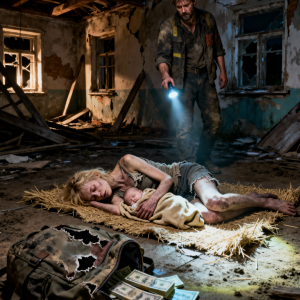
He pushed the gate open. It whined loudly. He stepped onto the porch and knocked. No answer. The doorknob felt loose as he twisted it. The door drifted open, and a smell hit him like a slap. Rot. Dampness. Something sour and medical. He fumbled for the light switch, but nothing responded. He lifted his phone and turned on the flashlight.
The beam cut through darkness and revealed a living room stripped of joy. Furniture pushed against walls. Stains across carpeting. A coffee mug with mold blooming inside. On the far side of the room, someone lay curled in a thin blanket.
“Tessa,” he whispered. His throat closed.
He dropped the backpack and rushed forward. The light shook wildly. Tessa’s face had hollowed into sharp angles. Her cheeks were sunken. Her skin looked gray beneath grime. Sunken eyes fluttered open. She stared for a second, as if thoughts took too long to connect.
“Miles,” she breathed. The word barely formed. “Is it really you.”
He pressed his hand to her forehead. Fever. A violent heat that terrified him. He glanced beside her and froze. Their son, Cal, lay tucked against her stomach, skin pale as candle wax. His breathing came out in tiny wet whistles, like each inhale was clawing for space.
Miles’s lungs collapsed inward. “God. Oh God.”
Tessa’s lips trembled. “I tried. I tried so hard. I asked for help. Nobody believed you would come back. They said you chose money instead of us.”
He felt something inside him crumble into dust. “I thought… I thought this would save us.”
She coughed sharply. Her voice rasped. “Save us. We needed you. Not this dream of fixing everything later.”
He gathered them both up in his arms. Cal’s small body felt light as if bones were missing. Tessa barely held onto his shoulders. He stumbled back toward the door, shouting into the cold.
“Somebody. Please. Help me. My wife. My son. Please.”
Porch lights snapped on across the street. A neighbor in a robe hurried across gravel. Another man jogged from his driveway yelling for someone to call the emergency line. Within minutes, a woman with silver hair pulled up in a pickup. She rolled down the window.
“Put them in the back,” she ordered. “I am driving.”

Miles nodded, too stunned to speak. He held Tessa and Cal close while the truck sped toward Colton Ridge Medical Center, the nearest hospital for thirty miles. Engines roared behind them as several neighbors followed, headlights chasing shadows.
Inside the emergency room, nurses lifted Cal from his arms. Someone guided Tessa to another stretcher. Miles sank to his knees in the hallway, hands over his face, sobbing uncontrollably. The backpack had fallen open during the drive. Bills spilled across the floor like a river of green. A nurse stepped over them without even glancing down.
A doctor appeared. His voice was firm, measured, and heavy with bad news.
“Your wife is severely malnourished. Her organs are under strain and she is fighting an infection. Your son has pneumonia and his lungs are struggling. We will do everything we can. They are both in critical condition.”
Miles stared past the doctor, toward a set of swinging doors. Tessa was somewhere behind them. Cal was in a room filled with machines.
“I left to give them a better life,” he said quietly.
The doctor did not speak. He only placed a hand on Miles’s shoulder for a brief second before moving on.
Hours passed. Nurses moved quickly through hallways. Monitors beeped. A woman in a flannel coat sat beside Miles. She clasped his shaking hand. He recognized her vaguely. Their neighbor. Janet Brookside.
“I checked on Tessa twice,” she said. “She said you were coming home. Everyone else said she was in denial. I should have pushed harder to help.”
Miles swallowed hard. “Where was my mother. She was supposed to look in.”
Janet hesitated. “She moved to Sacramento with your sister. She said she could not wait for you forever.”
The sentence drove a splinter straight into his chest.
His phone felt cold in his hand as he dialed his mother’s number. It rang twice before she answered. Laughter and music floated behind her voice.
“Miles. I heard you came back. Your sister told me.”
“They are dying,” he said. His voice cracked. “Tessa. Cal. They were starving. Alone.”
Silence. Then a sigh.
“You made your choices,” she murmured. “Sometimes you do not get to expect forgiveness.”
He stared at the white tile floor. Rage and sorrow interlocked like barbed wire. Without a word, he hung up. The phone clattered to the ground.
He turned to Janet. His voice sounded raw. “I thought money would fix everything. I thought it would make me worthy.”
Janet squeezed his shoulder gently. “Worthiness is not something you buy. It is something you choose every day. In the small moments.”
Through the window of the neonatal unit, Miles watched Cal resting in an incubator. Tiny tubes trailed from his nose. His chest rose and fell with fragile determination. Across the hall, Tessa slept under blankets, her skin pale but calmer now. IV lines kept time with her heartbeat.
Miles placed a palm against the glass dividing him from his son. He whispered, “If you stay. If you fight. I will never leave you again. I swear that the next sunrise we see together will be ours.”
Morning bled slowly into the sky. The hospital cafeteria filled with quiet voices. Miles had not moved from his chair. He watched Tessa stir. Her eyelids fluttered open.
He rushed to her side. She blinked up at him, confusion crossing her features before clarity settled in.
“You came back,” she whispered.
He nodded. “I am here. I am here now. I will not disappear again. I am sorry. I cannot undo what happened, but if you let me, I will rebuild piece by piece.”
Her gaze softened. She did not answer. She did not need to. The faint pressure of her fingers tightening around his spoke enough.
Two days later, doctors confirmed that both patients were stabilizing. Cal required weeks in the pediatric wing. Tessa would remain under observation for at least a month. Miles rented a room across the street from the hospital, refusing to be further than a heartbeat away.
He sold the land he once dreamed of turning into a workshop. He used half of his earnings to pay medical bills, and the rest he donated to the community pantry that had tried to support Tessa when she became too weak to stand in line.
Neighbors who once whispered about abandonment now brought blankets and soup. Janet visited daily to read to Tessa. A mechanic offered a job to Miles, no questions asked. For the first time, the world around him did not feel like a judgment, but an invitation.

Late one afternoon, as sunlight spilled through the blinds, Tessa watched Miles cradling Cal, who had regained enough strength to coo.
She said softly, “Do you know what I missed the most. It was not money. It was the sound of someone unlocking the door and knowing it was you.”
Miles kissed the top of Cal’s head. “I understand now.”
She reached out and touched his wrist. “Then let us move forward. Together. No more disappearing.”
Outside, Redwood Plains stretched quiet and humble, but alive. Miles realized that wealth was never a number. It was Tessa’s smile returning by centimeters. It was Cal’s fingers curling around his thumb. It was the weight of belonging to a home that had not given up.
He looked at them, heart full and bruised and beating fiercely. He understood that what matters is not the riches you carry back with you, but the courage to stay.
No treasure could rival the moment he walked through a doorway and found his family breathing, waiting, alive.