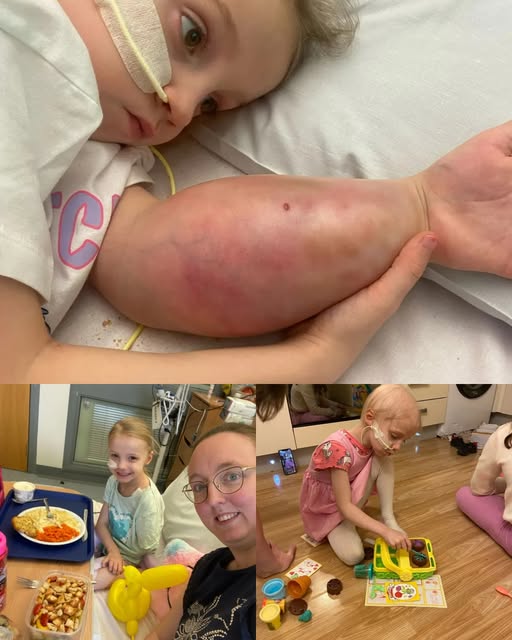
Five-year-old Bonnie Spence should be worrying about playground games, school uniforms, and what cartoon to watch before bedtime. Instead, her family has been told she may have less than a year to live—after doctors initially mistook her deadly cancer for a simple broken arm.
“Not in our wildest nightmares would we have thought we’d be in this position,” her dad, Iain, said quietly. And that sentence alone carries the weight of a family whose world collapsed in a matter of weeks.
It began with a lump on Bonnie’s arm.
At first, it didn’t seem like something life-changing. Bonnie was in pain, yes—but children fall, children bump themselves, children break bones. Her mum Zoe believed it might be a fracture. Local doctors agreed. They suggested it could be a sprain or break, sent Bonnie home with her arm in a sling, and reassured the family.

But the pain didn’t ease.
Bonnie’s arm continued to swell. The lump grew. Her discomfort turned into agony. She cried constantly, rolling in pain that no sling could relieve. Still, appointment after appointment passed without answers. Weeks stretched into months, and the fear that something was being missed grew impossible to ignore.
Two months later, Zoe made a decision that would change everything.
She drove Bonnie three-and-a-half hours to Newcastle, near her father’s home, because her instincts told her this was more than a broken arm. By the time they arrived, Bonnie was in unbearable pain. “She was rolling around,” Iain recalled. “She just couldn’t cope anymore.”

Doctors at the Royal Victoria Hospital took one look at Bonnie and knew something was terribly wrong.
The diagnosis came in February.
Stage four rhabdoid sarcoma—a rare and aggressive childhood cancer. The words felt unreal. This wasn’t a fracture. This wasn’t a sprain. This was a disease so fast-moving that it had already spread to Bonnie’s lungs.
By then, the pressure in her arm had become so severe that she developed compartment syndrome, a dangerous condition where swelling cuts off blood flow and causes extreme pain. Just five days after diagnosis, her parents were faced with a decision no parent should ever have to make.
Bonnie’s left arm had to be amputated.
There was no time to process, no time to grieve the loss of what should never have been taken. The choice was about survival—about stopping the pain, about giving her the best chance to keep living.

Now, doctors say Bonnie has less than a year.
Zoe describes the shock in simple, devastating words. “In the space of nine weeks, it went from a suspected broken arm to terminal cancer.” Chemotherapy is being used to prolong Bonnie’s life, but doctors have told the family it is expected to stop working around the 28-week mark. After that, there will be no further treatment options.
Bonnie currently remains in Newcastle with her dad, while Zoe faces long, expensive journeys to be with her daughter. Travel costs, adapted accommodation, and time away from work have created an unbearable financial strain on top of the emotional one. Bonnie’s needs—wheelchair access, medical support, and space to care for a child with one arm—mean even basic accommodation is costly.
Iain, an HGV driver, is living on statutory sick pay. His partner’s sick pay will soon run out. Zoe, a mother of five, is doing everything she can to stay close to her daughter while managing life hundreds of miles away. No part of this situation is easy. Every choice feels unfair.

Yet through it all, Bonnie remains Bonnie.
She smiles. She plays with playdough. She hugs her dad. She exists in moments of joy that feel almost impossible given what she is facing. Her family clings to those moments—because they are everything.
Iain hopes Bonnie’s story raises awareness of rhabdoid sarcoma, a cancer so rare that many parents—and even doctors—may never encounter it. “It just presented as a lump on the arm,” he said. And that simplicity is what makes it so terrifying.
Two GoFundMe pages have been launched—one to cover living costs and care, another to help with travel and creating memories while time still allows. Together, they have raised over £25,000, but the road ahead remains heavy and uncertain.

This is not just a story about cancer.
It is a story about how quickly life can change.
About listening when something feels wrong.
And about a little girl whose bravery far outweighs her years.
Bonnie Spence is five years old.
And she deserves to be seen.
