
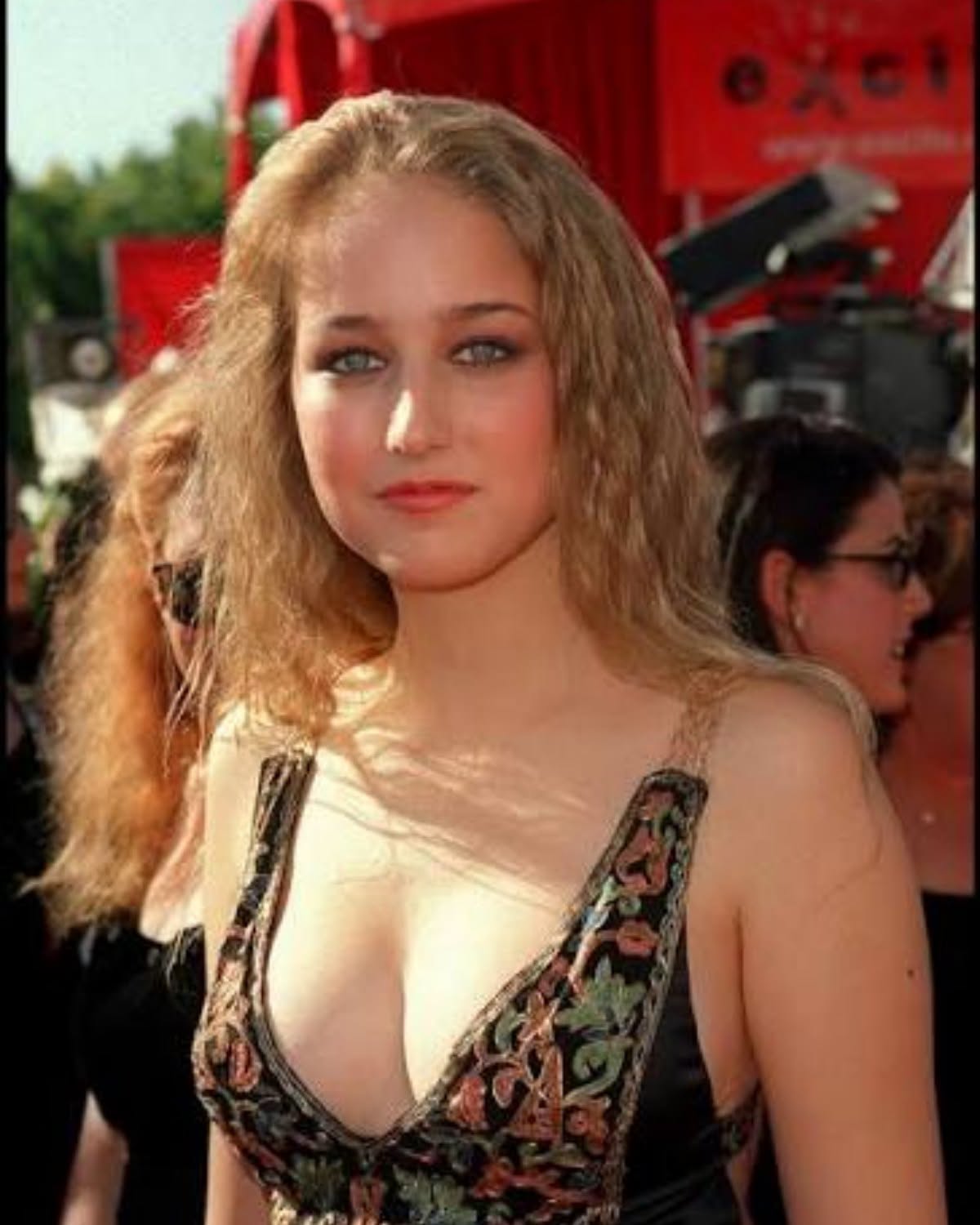
Leelee Sobieski had it all — Emmy nominations, blockbuster fame, Hollywood at her feet. Then at 29, she vanished.

She was 14 when Stanley Kubrick placed her in a dim costume shop, in a scene she was not allowed to fully understand. America remembered her as the brave girl Elijah Wood married in Deep Impact and the teenage Joan of Arc who earned an Emmy nomination. Then, before turning 30, she walked away and never came back.
Now, 14 years later, her own words suggest why. What she says about her first kisses may surprise you, and what she says about her children may explain the decision better than any headline.
She was born Liliane Rudabet Gloria Elzbieta Sobieski on June 10, 1983, in New York City. Her father, Jean, was a French-born painter who had once acted in European films. Her mother, Elizabeth, was a writer who would later produce films and manage her daughter’s career. The family lived among canvases and turpentine, and art was simply part of the furniture.
Most of the time, she later told The Brooklyn Rail, they had no living room, because that was where her father painted. As a little girl she drew constantly, because, as she put it, it “only calmed me down.” Acting was never part of the plan.
Around age 10 or 11, a casting agent spotted her in her Manhattan school cafeteria. Scouts were searching for a child to play the vampire Claudia in Interview with the Vampire, and the young New Yorker went in to audition. The part went to Kirsten Dunst, but a door had opened.
Years later she described the moment to the South Florida Sun-Sentinel as a deck of cards and a pile of chips dropped in front of her. “So, why not play poker?” she said. Even then, she kept telling people what she really wanted.
“I don’t want to act. I paint.” That is how she recalled it to Interview magazine. Her parents, she said, gently stopped her, because it sounded as though she wasn’t grateful. So she kept quiet and kept working.
She appeared in television films such as A Horse for Danny in 1995. In 1997 she made her big-screen debut as Martin Short’s daughter in the Disney comedy Jungle to Jungle. By 14 she was a working actress with an agent, a tutor, and a schedule that left little room for childhood.
Then came 1998, and the world learned her name. In the disaster epic Deep Impact, she played Sarah Hotchner, the teenager whose young sweetheart, played by Wood, marries her so she can join him in the government’s underground shelter. The image of the two teens racing a motorbike up a hillside as a tidal wave approached became one of the summer’s most memorable moments. The film earned nearly $350 million worldwide.
That same year she won acclaim in the Merchant Ivory drama A Soldier’s Daughter Never Cries. Many viewers noticed that the poised 15-year-old looked remarkably like a young Helen Hunt.
Then 1999 made her a star. She played Aldys, the earnest school newspaper editor who befriends Drew Barrymore in Never Been Kissed. On CBS she carried the title role in the miniseries Joan of Arc, becoming the youngest actress to play the French saint on screen. Viewers watched a 16-year-old lead armies, stand trial, and burn at the stake.
The performance brought nominations for both an Emmy and a Golden Globe. Hollywood began treating her as one of the most promising young dramatic actresses of her generation, and the offers poured in.
Joan of Arc was no small project. It was filmed on location in the Czech Republic, with a cast of legends. Peter O’Toole played the bishop who condemned her, and Jacqueline Bisset, Shirley MacLaine, and Maximilian Schell filled out the ensemble.
Each day, a teenager in armor faced actors who had been famous since before her parents were born. She held her own, and many who watched that May still remember the final scene at the stake. For a girl who once wanted only to paint, it was a remarkable achievement.
Yet the most unsettling credit of that year came from the most famous director in the world. Kubrick’s Eyes Wide Shut, starring Tom Cruise and Nicole Kidman, had been shooting in England for well over a year. Sobieski was cast as the daughter of Milich, a costume shop owner played by Rade Šerbedžija.
In her brief scene, Cruise’s character arrives late at night to rent a mask and cloak. He finds the girl in the back of the shop with two older men, and the film later suggests her own father is selling her. She was 14 when she filmed it. According to Vice, she was not told the full context of the scene until the movie was released.
Kubrick died in March 1999, days after showing his final cut to the studio, and the film opened that July to enormous curiosity. It is a picture about masks, about powerful people hiding behind beautiful faces, and about what happens when the curtain is pulled back.
Sobieski has never publicly blamed the film for her later choices. Some fans nonetheless read that scene as a quiet warning. Others point out that Kubrick’s defenders see it as a depiction, not an endorsement, of exploitation, and that nothing she has said ties her exit to that set.
Behind the magazine covers and award nominations, the teenager was carrying a heavy load. “I started paying the rent on our house when I was 15,” she told a magazine in 2018. According to The New York Times, she often went straight from school to photo shoots without changing clothes. On sets, she kept up with classes through an onset tutor.
Her mother managed her career, and the household depended on a teenager’s paychecks. Few fans imagined the weight on those young shoulders.
That was the strange bargain of teenage stardom at the end of the 1990s. Girls her age were celebrated as rising stars, yet often handed roles written to make them seem older, more knowing, and more desirable to grown men. Agents and studios saw opportunity, and young actresses were expected to smile and say yes.
Sobieski said yes for years, partly because her family needed the income. Only much later did she find words for how it felt.
There was another burden she rarely discussed until she had left the business. Teenage roles came with romance, and romance meant kissing scenes. For her, they were a private torment hidden from the cameras.
“I would cry every time I had to kiss somebody.” That is what she said. Some of the earliest kisses of her life happened in front of a camera crew. “It was real for me,” she explained, because it was her first or third, and so it was confusing.
Then she asked a question that cut to the heart of the business: “Why is my kiss for sale?” It made her feel “really cheap,” she said.
The pressure did not stop at the kiss. She described how an entire production could nudge a young actress toward feelings she did not have. With 150 crew members, she told Artnet News, “everybody is rooting for it.”
In 2000 she starred in the teen romance Here on Earth, as a small-town girl torn between Chris Klein and Josh Hartnett. Critics were unkind, and the film holds just 17 percent on Rotten Tomatoes. Still, studios kept casting her as the object of other people’s desire.
By 2001 she seemed to be everywhere. In The Glass House, she played an orphan trapped with sinister guardians played by Diane Lane and Stellan Skarsgård. In My First Mister, she was a lonely goth girl who befriends a middle-aged man played by Albert Brooks.
On the set of the road thriller Joy Ride, opposite Steve Zahn and a young Paul Walker, she missed her own high school prom. Director John Dahl told the Baltimore Sun that the crew felt so bad they chipped in for flowers. The miniseries Uprising that year brought her a second Golden Globe nomination.
Fans who revisit Joy Ride feel a special ache, since Walker died in a car crash in 2013 at 40. For Sobieski, the strain was already showing. She told the Baltimore Sun she disliked that her salary had become public knowledge, and told the New York Daily News she would be fine if she never became a bigger star.
“I hope to do many things in my life,” she said. Then she made a decision that surprised the industry. At 18 she enrolled at Brown University and moved into a shared dorm room.
“If I’m going to have the college experience, now’s my time,” she told the Baltimore Sun. She studied literature and fine art, and painted whenever she could. The first year was anything but easy.
After September 11, she later recalled, her parents separated, “among other complicated circumstances.” Even then she was asking herself a striking question. “What happens if this is my last film?” she told the Daily News in 2001.
She left Brown after about two years and returned to work full time. But the magic of her teenage years seemed to fade with each release. She starred opposite John Cusack in Max in 2002 and appeared in a French miniseries of Les Liaisons Dangereuses.
In 2006 she turned up in the much-mocked remake of The Wicker Man with Nicolas Cage. Her 2008 roles in the Al Pacino thriller 88 Minutes and the fantasy flop In the Name of the King drew a Razzie nomination. The girl once up for Golden Globes was now in films critics loved to ridicule.
Even in those lean years, she knew who she wanted to become. At 23 she told Purple magazine, “I want to be a director, a painter, and a writer of children’s stories, and a mother.” Acting appeared nowhere on the list.
Looking back, that sentence reads like a map of the life she would build. At the time, few in Hollywood were listening.
Then, in January 2009, her life changed in a way no role ever had. She began dating Adam Kimmel, a New York menswear designer known for a quiet, artistic style. By May they were engaged, and in December she gave birth to a daughter, Louisiane. They married in 2010.
For the first time since childhood, she had a life that did not revolve around a call sheet. She still took small parts, including one in Michael Mann’s Public Enemies, but her heart was elsewhere. Motherhood, she would say, made everything clear.
In 2012 she said it out loud in Vogue. “90% of acting roles involve so much sexual stuff,” she said, and she did not want to do that. “It’s such a strange fire to play with,” she added.
That spring she played a rookie cop in the CBS drama NYC 22, produced by Robert De Niro’s company and set on the streets of her hometown. It was a respectable, grown-up role, far from the teen romances. The show was canceled after one season, and the thriller Branded followed that September.
Then, at 29, with two Golden Globe nominations and more than 30 film and television credits behind her, Leelee Sobieski simply stopped. Later she explained it in one quiet sentence: “So when I could, I stopped.”
The reasons ran deeper than a bad script. Actors, she told Artnet News, go from role to role and “just become emptier and emptier.” You end up, she said, with “no real experiences.”
Then came the reason that resonated with parents everywhere. She did not want her children to see her on Netflix “in the arms of someone who’s not their dad.”
Those expecting a comeback were disappointed. In 2014 she and Kimmel welcomed a son, Martin, and the family settled into a quiet life in Red Hook, Brooklyn, far from Los Angeles red carpets. When Us Weekly caught up with her in 2016, she was plain about it. “I don’t do movie stuff anymore. I am totally an outsider,” she said.
Her children, she added, were the main reason. Her husband also stepped back from fashion, and the couple chose privacy over publicity.
The family built a weekly ritual to protect that peace. According to Oprah.com, from Friday night to Saturday night they turn off phones, internet, and television, and spend those hours outdoors with friends and each other. For a woman raised under studio lights, that weekly silence was a gift.
What almost no one knew was that she had been painting all along. “Painting was always my goal,” she told Artnet News. She had lined her trailer walls with plastic so she could paint between takes. “I always acted to be able to afford paints,” she said, and she kept working “in secret.”
Around 27, she said, she finally made room to devote herself fully to art. When she entered the art world, she did so under a different name. She signed her canvases Lily Kimmel, and she was afraid of how people would react.
“I thought that because of my past, my work would be judged harshly,” she told Artnet. In 2018 she held her first solo show, Channels, at the Journal Gallery in Brooklyn. Critics praised her swirling, electric abstractions. That same year she opened Wormhole at Simon Lee Gallery in London, and she even made works in virtual reality with a digital painting tool.
“This is really what’s inside of me,” she said of the paintings. It was the first time in her adult life that she had made something entirely her own.
Looking back on the business that raised her, she has spoken bluntly. “It’s kind of a gross industry,” she said in 2018, though she added that they all are when you examine them. She also questioned the idea of child stars. “I don’t know why it’s legal for a child to act,” she said.
Not everyone shares that view. Many in the industry argue that child performers can thrive with strong guardians, tutors, and legal protections, and Sobieski herself has said she had a happy childhood. Critics counter that the system still leans on children’s earning power, and her own account of paying rent at 15 gives that argument weight.
In 2024 she sat down with The Brooklyn Rail and spoke of her father’s paintings filling the living room. “Although I acted early on, I always wanted to be a painter,” she said. The circle that began there had closed. The little girl who calmed herself with crayons now shows work in galleries in New York, Paris, and South Korea.
She keeps her personal life almost entirely private. Her social media rarely shows anything but her art, and she has never returned to a film set. On June 10, 2026, she turned 43, and photographers spotted her walking through Manhattan in a white blouse and blue pleated skirt, smiling and relaxed.
Her daughter is now 16, already older than Leelee was when Kubrick cast her. Somewhere in that fact lies the quiet power of her choice. Her children are growing up in a home where no one sells their kisses and no one pays the rent at 15.
So why did Leelee Sobieski quit Hollywood? She has never blamed a single director, film, or person. “I had a really happy childhood,” she told Artnet, and she is proud of some of the work. Instead, she has told the truth in pieces over 14 years.
A child was asked to carry the rent and the romance of grown-ups. Her first kisses were played for strangers, and the work left her emptier. When she became a mother, she chose not to let her children watch her in another man’s arms. Beneath it all, she had always been a painter.
In Eyes Wide Shut, masked guests hide their faces while a young girl is quietly bartered in the back of a shop. Fourteen years ago, the girl from that film took off her own mask and walked away. She did not leave in scandal or defeat. She left with her family, her brushes, and her dignity intact.
Leelee Sobieski is gone from the screen. Leelee Kimmel, the painter she always wanted to be, is only just beginning.