
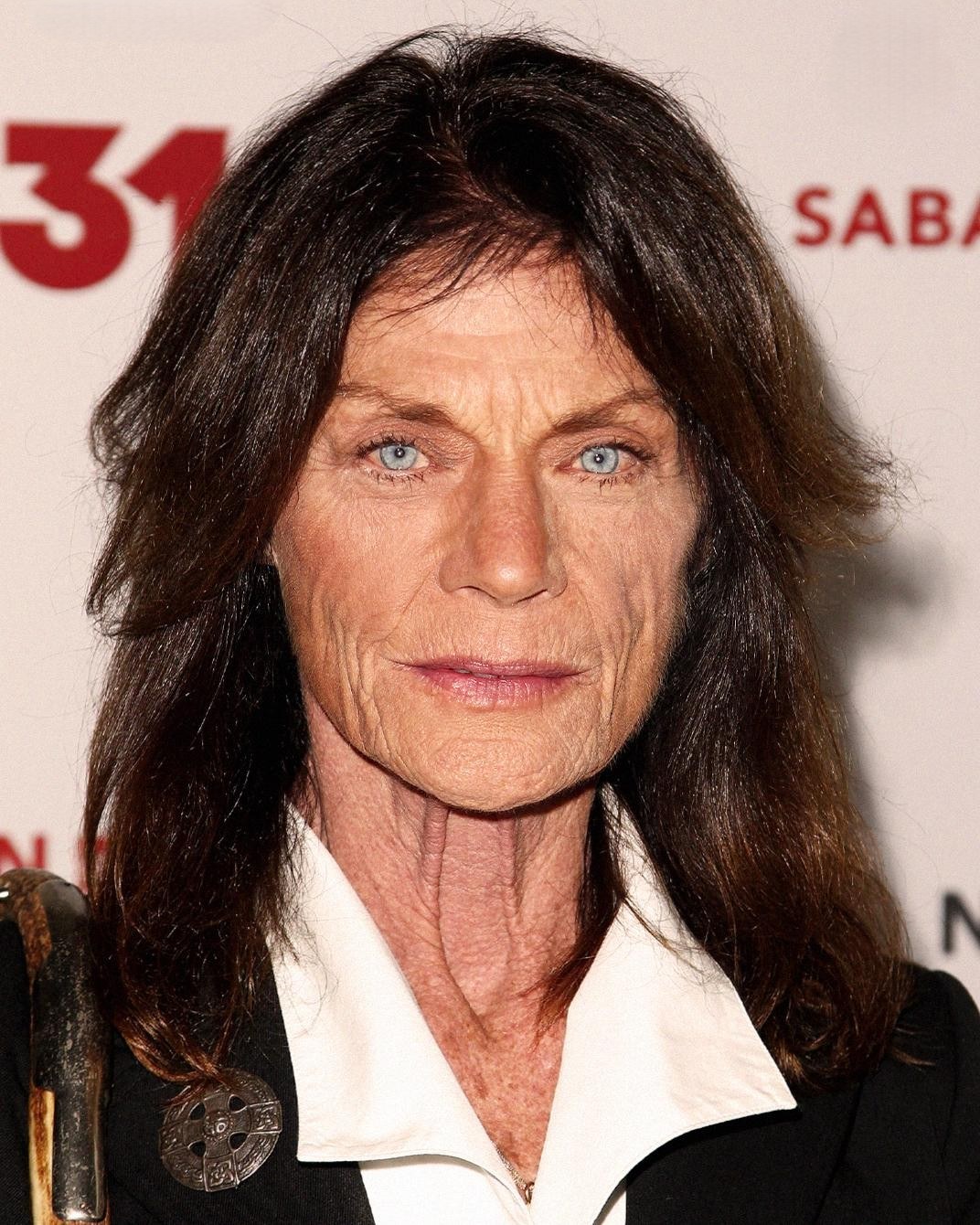
In the dynamic and ever-evolving world of television during the 1970s and 1980s, few performers possessed a presence as unforgettable as Meg Foster. She stood apart not only because of her acting ability, but also due to a rare and captivating physical feature that audiences could not ignore—her strikingly pale, almost luminous blue eyes. These eyes, often described as icy or otherworldly, became a defining characteristic of her on-screen identity. Viewers frequently assumed that such an intense color must have been enhanced with special effects or contact lenses. In truth, they were entirely natural, a unique trait that both distinguished her and, at times, complicated her journey in an industry that often favored more conventional standards of beauty.
Foster’s appeal lay in a compelling contrast. She had an ethereal quality, something almost mystical, yet at the same time she conveyed a grounded realism that gave her performances emotional weight. This duality allowed her to portray a wide range of characters, from vulnerable and introspective figures to commanding and enigmatic personalities. While her eyes eventually became her signature, early in her career they were occasionally viewed as a distraction rather than an asset. Some producers worried they might pull focus away from the story itself, highlighting how rigid expectations in Hollywood could sometimes clash with individuality.
Born in 1948 in Reading, Pennsylvania, Foster grew up in Connecticut as part of a large family with five siblings. Her upbringing fostered a natural curiosity about people and their inner lives, which would later become a cornerstone of her acting style. Rather than chasing fame, she approached acting as a craft to be studied and mastered. This mindset led her to enroll at the renowned Neighborhood Playhouse School of the Theatre in New York City, where she trained under the influential acting teacher Sanford Meisner. Meisner’s philosophy emphasized authenticity, encouraging actors to respond truthfully in the moment rather than perform artificially. This training deeply shaped Foster’s approach, giving her performances a sincerity that resonated with audiences.
Her early work was rooted in theater, where she honed her skills by performing in classic plays such as She Stoops to Conquer and works by George Bernard Shaw. These stage experiences provided her with a strong foundation, instilling discipline and emotional depth. When she transitioned into film and television in the late 1960s and early 1970s, she brought that same theatrical intensity with her, setting her apart from many contemporaries who lacked similar training.
By the mid-1970s, Foster had established herself as a familiar face on television. She appeared in a variety of popular series, including Hawaii Five-O and The Six Million Dollar Man. These guest roles showcased her versatility and helped her build a steady career. However, her true breakthrough came in 1979 when she was cast as Hester Prynne in a television adaptation of The Scarlet Letter. The role demanded emotional vulnerability and complexity, and Foster delivered a performance that impressed critics and industry professionals alike.
Despite this success, her journey was far from smooth. Before landing that pivotal role, she endured a prolonged period of unemployment lasting over a year. This time was marked by self-doubt and uncertainty, as she questioned her place in an industry that often seemed unforgiving. She later spoke candidly about these struggles, describing them as both frightening and emotionally draining. Like many actors, she grappled with insecurities about her appearance and whether she fit the mold of a traditional leading lady.
Following her acclaimed performance in The Scarlet Letter, Foster appeared poised for even greater सफलता. She was cast as Detective Christine Cagney in the early episodes of Cagney & Lacey, a role that seemed perfectly suited to her intensity and presence. However, in a surprising turn of events, she was dismissed from the show after only a short time. She was replaced by Sharon Gless, and the decision sparked widespread speculation. Official explanations were vague, and the lack of clarity gave rise to rumors that negatively affected Foster’s reputation.
This abrupt setback had a significant impact on her career. Opportunities that once came easily began to diminish, and she found herself navigating an industry that had suddenly become less welcoming. Foster later described the experience as deeply traumatic, likening it to a sudden and forceful blow that forced her to reassess her path forward.
Rather than allowing this moment to define her, she made a deliberate shift away from mainstream television. She turned her attention to independent films and genre cinema, where unconventional looks and bold performances were often celebrated. This decision marked a turning point, enabling her to embrace roles that highlighted her uniqueness instead of suppressing it.
One of her most memorable performances during this period came in the 1987 fantasy film Masters of the Universe, where she played the villainous Evil-Lyn. The role allowed her to fully utilize her striking appearance, transforming what had once been seen as a limitation into a powerful storytelling tool. Her performance demonstrated her ability to command attention and bring depth to even larger-than-life characters.
She further solidified her status as a cult favorite with her role in They Live, directed by John Carpenter. The film, a blend of science fiction and social commentary, has since become a classic within its genre. Foster’s performance added an air of mystery and intrigue, and her distinctive eyes became an integral part of the film’s visual identity.
Throughout the 1990s, Foster continued to work steadily, making guest appearances on well-known television series such as Star Trek: Deep Space Nine and ER. Although she remained active, her approach to her career began to shift as she entered a new phase of life. Rather than pursuing constant visibility, she became more selective about the roles she accepted.
This change reflected a broader decision to prioritize personal fulfillment over professional ambition. Foster chose to step away from the pressures of Hollywood and embrace a quieter lifestyle. She settled in Topanga Canyon, a serene area known for its natural beauty and artistic community. There, she lived with her former husband, Stephen McHattie, and their son.
Life in Topanga offered a stark contrast to the fast-paced entertainment industry. Foster found joy in simple, everyday activities—cooking, spending time with family, and connecting with nature. She even shared glimpses of this lifestyle publicly, discussing her favorite recipes and reflecting on the realities of motherhood with honesty and humility. Her willingness to embrace imperfection made her relatable in a way that many celebrities were not.
As the years passed, her reduced presence in mainstream media led some to wonder what had happened to her. In reality, she had not disappeared at all—she had simply chosen a different path. When she did return to acting, including roles in films by Rob Zombie, she brought with her a sense of authenticity that remained unchanged.
One of the most notable aspects of her later career was her decision to age naturally. In an industry where cosmetic enhancements are common, Foster chose to embrace the passage of time. Her appearance reflected a life lived fully, and audiences responded with admiration. Her enduring blue eyes remained as captivating as ever, but they were now accompanied by a depth and character that only experience can bring.
In many ways, Foster became a symbol of resilience and individuality. She defied expectations at multiple points in her career—overcoming typecasting, navigating professional setbacks, and ultimately redefining success on her own terms. Her story resonates particularly with those who feel marginalized by societal standards, serving as a reminder that uniqueness can be a strength rather than a weakness.
Today, her legacy is one of authenticity and artistic integrity. She never pursued fame for its own sake, nor did she conform to industry pressures at the expense of her identity. Instead, she remained committed to portraying characters with honesty and depth. Whether appearing in a period drama, a science fiction film, or an independent project, she brought a consistent sense of truth to her work.
For audiences who continue to discover her performances, the fascination remains. Her gaze, once described as unforgettable, still holds the same power. Yet her story goes beyond physical appearance. It is about perseverance, self-acceptance, and the courage to forge one’s own path.
Rather than fading away, Meg Foster simply stepped into a life that aligned with her values. In doing so, she demonstrated that success is not always measured by visibility or fame, but by the ability to live authentically and remain true to oneself.